Britain Weighs Naval Drone Deployment as Iran Blockades Strait of Hormuz
Royal Navy evaluates autonomous mine-hunters and interceptor systems to reopen the world's most critical maritime energy artery
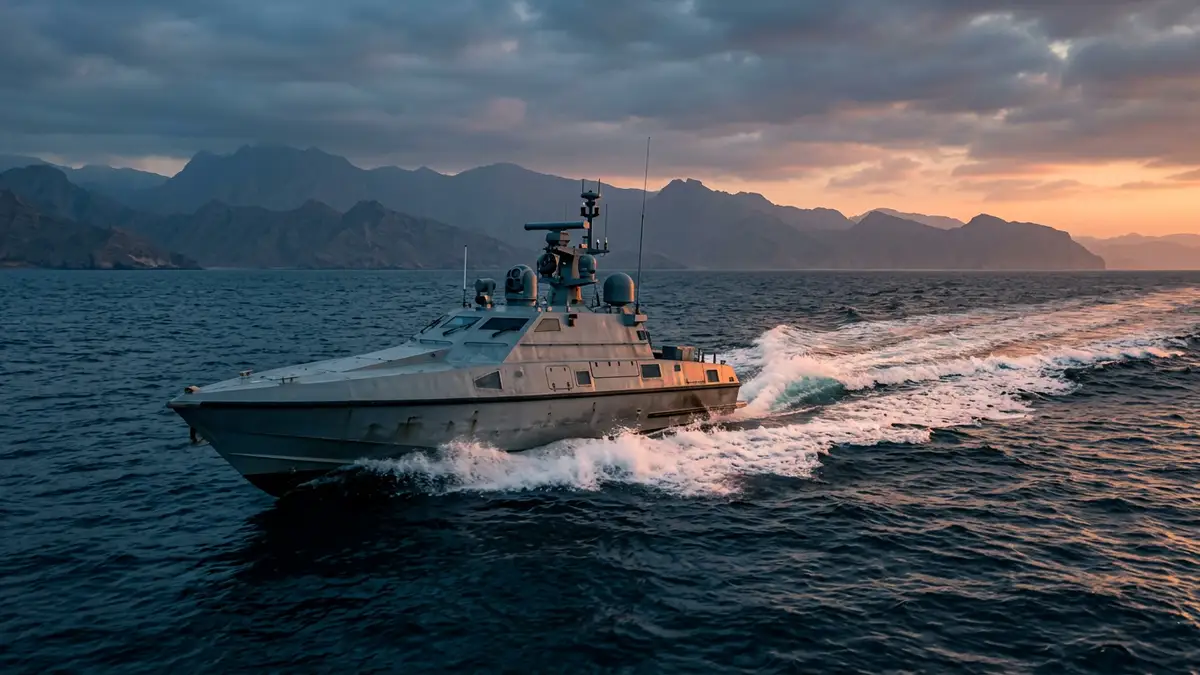
Image: Matt Weston / AI

Carla Rooney
The United Kingdom is evaluating the immediate deployment of advanced naval drones to the Middle East after Iran blockaded the Strait of Hormuz, halting 20 percent of the world's liquid petroleum consumption.
President Donald Trump confirmed that the United States executed kinetic strikes on military targets across Kharg Island. He asserted that these operations crushed the conventional strength of the Iranian military.
Thirteen Americans died as the U.S. Navy navigates an active 'kill box' in the strait. Trump stated the United States will continue bombing the shoreline and shooting Iranian vessels out of the water.
The United States will continue bombing the shoreline and shooting Iranian vessels out of the water.
The Strait of Hormuz serves as the world's most volatile maritime chokepoint, echoing the 'Tanker War' of the 1980s. During that era, over 500 ships sustained attacks.
The current integration of autonomous drone swarms represents a fundamental shift in naval mechanics. Mojtaba Khamenei, the new supreme leader of Iran, vowed to maintain the blockade as a primary lever of pressure.
Tehran dismissed claims that its military capabilities are crippled. Officials labeled such statements as fabricated lies.
The White House expects the United Kingdom, China, France, Japan, and South Korea to dispatch warships to the region. This international coalition faces the task of clearing mines while under the threat of close-range missile batteries.
Shadow Energy Secretary Claire Coutinho stated that a British response to the call for protective ships requires immediate exploration. Political pressure mounts as the U.S. Navy warns that sending sailors into the strait risks making them targets for missile strikes.
Energy Secretary Ed Miliband argued that the crisis confirms the necessity of a transition toward home-grown clean power. He noted that ramping up North Sea oil and gas production would make no material difference to current global energy prices.
Ramping up North Sea oil and gas production would make no material difference to current global energy prices.
Miliband committed that the government would stand by the British people during the escalating energy crisis. The closure of the strait threatens to destabilize global markets and spike domestic heating costs.
The United States noted that while Tehran now seeks a deal to end the war, the current terms offered by Iran remain insufficient. Trump acknowledged it remains easy for Iran to deploy mines or close-range missiles despite the decapitation of their command structures.
Industry experts suggest that a prolonged closure could lead to a permanent shift in how global powers secure maritime energy routes. The reliance on the Strait of Hormuz defines a strategic vulnerability for Western economies.
The Royal Navy's pivot toward autonomous systems reflects a broader industry shift toward removing human personnel from high-threat 'kill zones.' These drones provide a persistent surveillance and neutralization capability that traditional minesweepers cannot match.
Trump asserted that the United States will soon force the Hormuz Strait open, safe, and free through continued kinetic operations. He maintained that the objective remains the total restoration of international shipping rights in the Persian Gulf.
The U.S. Navy continues to monitor the shoreline for mobile missile launchers and drone deployment sites. Military planners remain focused on the technical challenge of clearing underwater explosives while under active fire from the coast.
The Strait of Hormuz remains the focal point of this global confrontation, with its narrowest point spanning only 21 miles. Every barrel of oil delayed at this chokepoint adds to the mounting economic pressure on international stakeholders.