Global Energy Flows Stagnate as Strait of Hormuz Shipping Halts
Oil prices fluctuate and G7 ministers mobilize as military operations and GPS jamming paralyze the world’s busiest oil transit corridor.
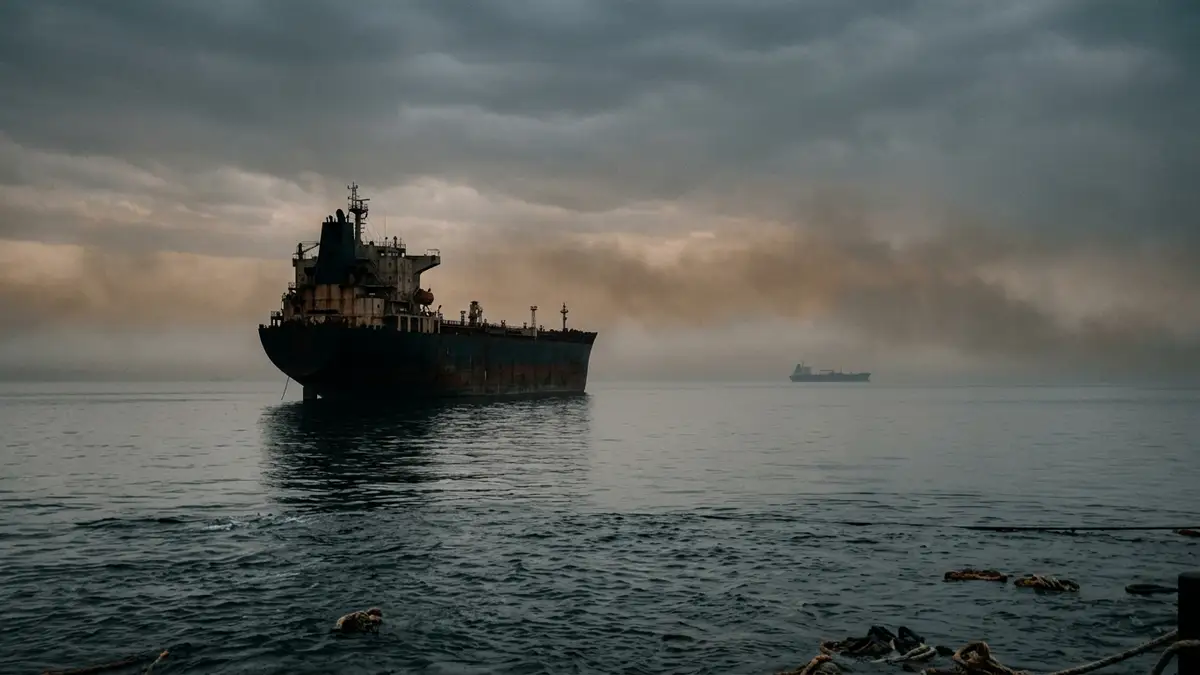
Image: Matt Weston / AI

Sarah Connor
Shipping traffic through the Strait of Hormuz has reached a near-standstill following the onset of a US-Israeli military offensive against Iran.
The Islamic Revolutionary Guard Corps (IRGC) enforced this silence by issuing a directive to strike any US, Israeli, or European vessel detected within the passage.
This blockade forced the majority of commercial operators to drop anchor or divert entirely away from the Gulf.
Market volatility spiked on Monday as oil prices surged to $119 a barrel, marking the highest valuation since 2022.
Prices later retracted to levels below $90 as traders reacted to the shifting accessibility of the passage.
Military analysts identify Iran as the primary actor behind the physical disruption of these commercial vessels.
These maneuvers coincide with a broader electronic warfare campaign currently degrading the region's navigation systems.
Beyond the physical blockade, Thomas Withington confirmed that US forces are deploying jamming systems across the area.
These electronic countermeasures aim to protect personnel, bases, and vessels from drones and weapons guided by Global Navigation Satellite Systems (GNSS).
This GPS jamming has expanded beyond the immediate war zone, affecting civilian aircraft across Europe.
The technology has become a daily feature of the ongoing war in Ukraine, complicating international aviation safety protocols.
In response to the maritime freeze, Donald Trump announced a $20 billion reinsurance scheme designed to incentivize shipowners to resume transit.
Show some guts
He stated that shipowners should 'show some guts' by sailing through the active war zone.
Meanwhile, G7 finance ministers released a joint statement confirming they are ready to take necessary measures to support the global supply of energy.
This coordination follows the sudden removal of Middle Eastern crude from the immediate market.
Lloyd's List Intelligence now defines the remaining active vessels in the region as a shadow fleet.
These tankers are specifically classed by their transport of sanctioned oil cargo from Iran, Russia, or Venezuela.
Expert analysis from Matthew Wright indicates that a diplomatic solution could restore shipping flows within one to three weeks.
He identified China as the probable lead negotiator due to the extreme risk the blockade poses to Asian economies.
The duration of the crisis remains tied to Iranian military tactics.
If Iran employs a decentralized warfare approach, the disruption to global shipping could persist for months.
Wright noted that if Iran employs a decentralized warfare approach, the disruption to global shipping could persist for months.
This current blockade mirrors the 'Tanker War' of the 1980s, where hundreds of merchant ships were targeted in the Persian Gulf.
The integration of modern electronic warfare adds a layer of complexity not seen in previous decades.
Economic pressure crushes G7 nations as the sudden removal of Middle Eastern crude threatens industrial output.
Finance ministers are currently weighing strategic reserve releases to stabilize the $90-per-barrel floor.
The IRGC's threat to strike European vessels has effectively internationalized the conflict beyond the initial US-Israeli scope.
Insurance premiums for the few vessels remaining in the region have reached prohibitive levels.
Aviation authorities in Europe report increased interference with flight paths due to the spillover of GNSS jamming.
This electronic interference creates a secondary zone of disruption far removed from the physical combat in the Strait.
China's role as a potential mediator stems from its status as the largest buyer of Iranian oil.
Any prolonged closure of the Strait threatens the energy security of the world's second-largest economy.
The shadow fleet continues to operate under high-risk conditions, bypassing the standard maritime safety protocols.
These vessels remain the only active link for sanctioned crude moving through the contested waters.
Military analysts suggest the use of decentralized warfare by Iran could involve small-boat swarms and mobile missile batteries.
Such tactics make the complete reopening of the Strait a difficult prospect for conventional naval forces.