US and Israel Strike Iran as Revolutionary Guards Blockade Strait of Hormuz
Global oil prices surge 10 percent as Iranian drones strike tankers and military infrastructure across the Persian Gulf
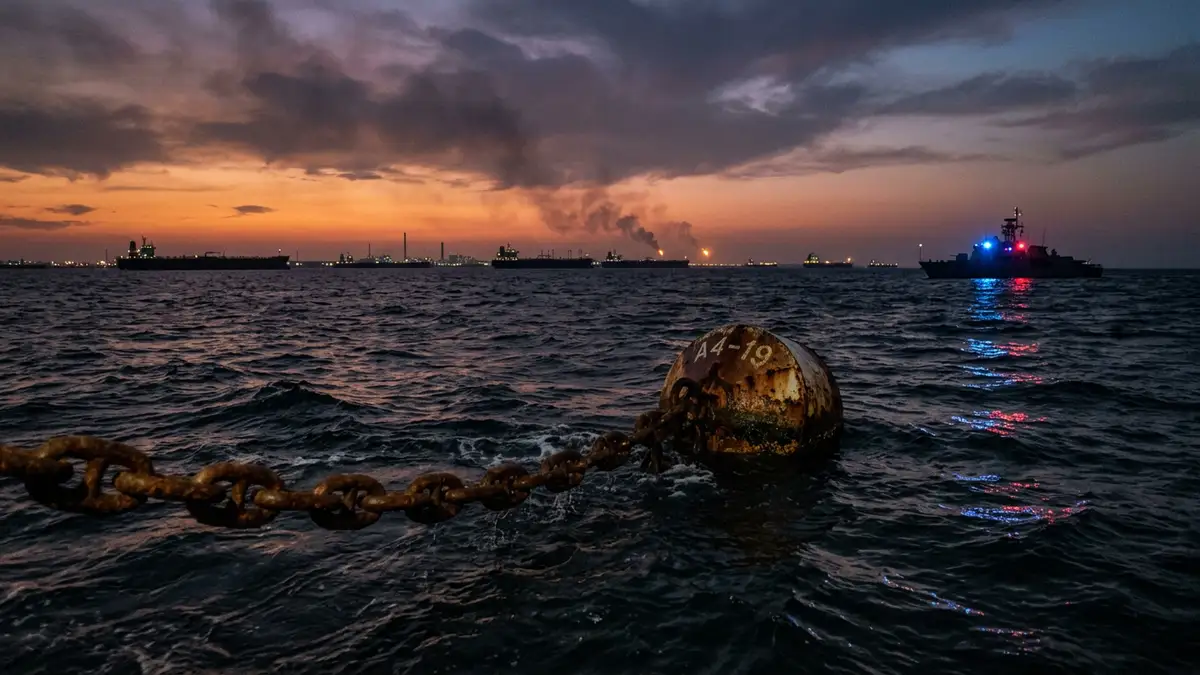
Image: Matt Weston / AI

Sarah Connor
The United States and Israel launched coordinated military strikes against Iranian infrastructure, prompting the Islamic Revolutionary Guard Corps to immediately blockade the Strait of Hormuz.
Financial analysts at Goldman Sachs and Barclays indicate that prices could exceed $100 per barrel if the supply disruption remains unmitigated.
Physical violence against maritime assets began shortly after the initial strikes, with one oil tanker bursting into flames after being struck by Iranian drones.
This specific aerial assault resulted in injuries to four mariners on board. Iranian state television confirmed another tanker began sinking after it was struck while attempting to pass through the waterway.
A second vessel, the Marshall Islands-flagged MKD VYOM, was hit by a projectile off the coast of Oman.
The Islamic Revolutionary Guard Corps (IRGC) enforces the blockade despite the absence of a formal verification to international maritime bodies.
An engine room fire broke out on a vessel north of Oman and east of the strait. Most international shipping firms responded by halting all operations in the region as crews brought the fire on the unidentified vessel under control.
Data from Kpler analytics estimates that five tankers currently stalled in the area have the capacity to carry 10 million barrels of oil.
The Strait of Hormuz historically functions as the world's most critical oil chokepoint, averaging over 20 million barrels per day in 2023.
Oil prices exceeding $100 represent a clear and present danger to global stability.
This bottleneck follows repeated warnings from regional leaders to Washington that oil prices exceeding $100 represent a clear and present danger to global stability.
Beyond the maritime corridor, the conflict expanded to include strikes on naval bases used by the United States and the port of Jebel Ali in Dubai.
Debris from an aerial interception over the Dubai port caused at least one fire on the docks. IG market data indicates that US crude oil is on track to rise by 9 percent when trading resumes.
Helima Croft, an analyst at RBC Capital, stated that a total closure of the strait could drive prices 37 percent higher than Friday's closing level of $72.
A total closure of the strait could drive prices 37 percent higher than Friday's closing level of $72.
In response to the volatility, OPEC+ members moved to increase output by 206,000 barrels per day starting in April.
This figure exceeds the original production target of 137,000 barrels per day previously discussed by the cartel.
Eight member nations reached this agreement in principle to provide a buffer against the loss of Iranian and regional supply.
Traders in New York suggest prices could still reach $73 per barrel in the immediate term regardless of the output hike.
The US and Israeli strikes targeted Iranian infrastructure following months of escalating regional friction.
Military officials have not yet released the full list of targets hit during the initial wave of the bombardment.
Shipping lanes remain congested as tankers sit stuck in the narrow waterway with no clear path for exit.
The Revolutionary Guards continue to patrol the entrance to the Persian Gulf to enforce the transit ban.
Economic pressure on Washington remains high as Middle East leaders reiterate the contagion risks of a sustained confrontation.
These leaders previously cautioned that a war with Iran would destabilize energy markets beyond the point of rapid recovery.
Current IG market data shows US crude oil is positioned for a significant gap up at the opening bell.
The UKMTO continues to monitor the engine room fire and other distress signals originating from the Gulf of Oman.
The Strait of Hormuz remains the focal point of the crisis, with its 21-mile width creating a natural tactical advantage for the IRGC's fast-attack craft.
Military analysts suggest the blockade could persist as long as the aerial bombardment of the Iranian mainland continues.
The situation remains fluid as global powers weigh the economic cost of a prolonged maritime shutdown.