U.S. Military Engages Iran as Strait of Hormuz Shipping Halts
Refueling aircraft crash and maritime blockade trigger heaviest American air campaign in decades
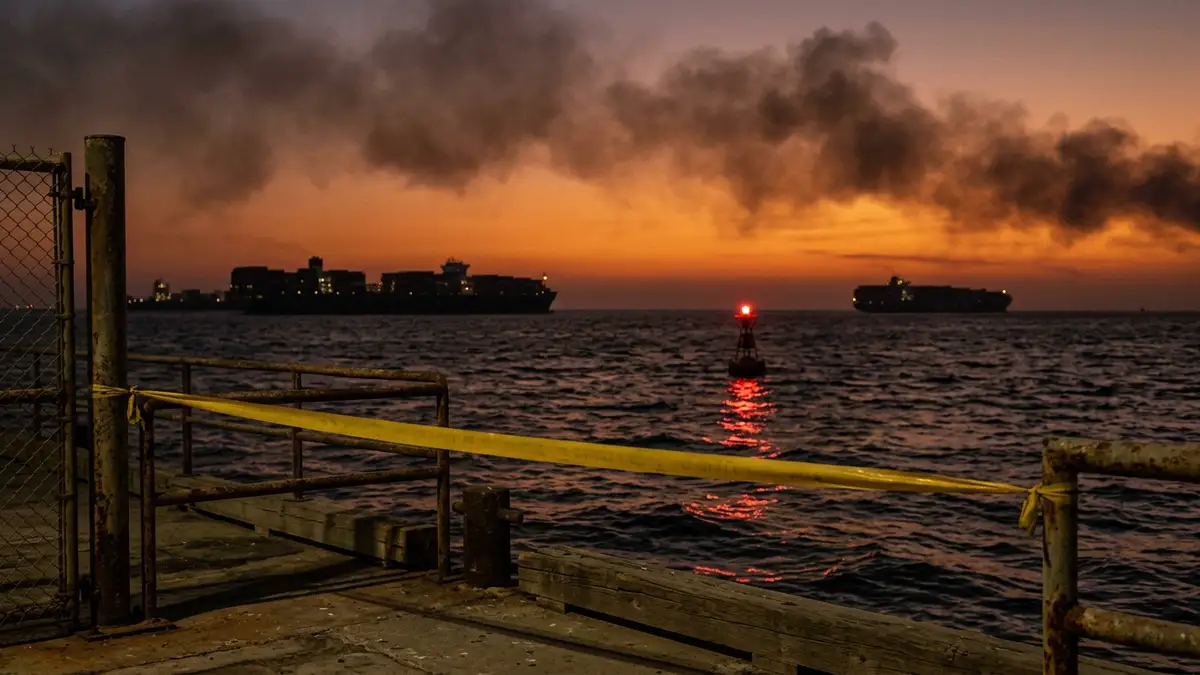
Image: Matt Weston / AI

Sarah Connor
The United States military has entered a state of open war with Iran following a massive escalation that has effectively halted commercial shipping in the Gulf and the Strait of Hormuz.
The Islamic Resistance in Iraq claimed responsibility for downing the aircraft. All six personnel on board died in the crash.
Defense Secretary Pete Hegseth confirmed the military will strike Iran today with the heaviest firepower deployed since the war began on February 28. This 13-day campaign has already dismantled enemy infrastructure through thousands of precision sorties.
Hegseth characterized the offensive as an unprecedented success. He noted that Iran currently lacks a functioning air force, navy, or missile defense network.
American forces killed the Supreme Leader, Ayatollah Khamenei, during the initial stages of this relentless air campaign. His successor, Mojtaba Khamenei, suffered disfiguring wounds during the strikes.
Mojtaba Khamenei vowed to keep the Strait of Hormuz closed to all maritime traffic. He demands that the U.S. and Israel pay compensation for the bombardment of Iranian cities.
Iran officially designated the Strait of Hormuz a closed zone and began laying mines throughout the waterway. At least three tankers have already been struck by unknown projectiles.
This naval confrontation mirrors the 1988 battle between the U.S. Navy and Tehran in these same volatile waters. Mark Almond noted that Donald Trump has predicted a similarly decisive victory over the remnants of Iran's current surface fleet.
Oil prices surged past the $100-a-barrel threshold immediately following the blockade. U.S. Treasury Secretary Scott Bessent reported that these disruptions have already cost the country $11 billion in lost value.
The vast majority of those killed in the strikes were civilians caught in the crossfire.
Bessent maintained that U.S. Navy escorts for commercial vessels could begin shortly to restore the flow of international trade. This shift follows Donald Trump’s deployment of U.S. Marines and warships to the Middle East.
Explosions rocked Dubai as Iran launched fresh attacks targeting the city’s International Finance Centre. Thick plumes of smoke rose above the skyline following the strikes on this regional economic hub.
Two Iranian drones attacked British troops stationed at a joint U.S. and UK military base in Iraq. In response, B-2 stealth bombers took off for new missions as the air campaign intensifies across the theater.
Gen Dan Caine confirmed the U.S. fired the first precision strike missiles ever used in combat to reach deep into enemy territory. Hegseth claimed that Iranian ballistic missile production capacity is now functionally defeated.
Security chief Ali Larijani marched with crowds in Tehran to demonstrate against Israel on the final day of Ramadan. The Iranian government maintains that its leadership and national resolve persist despite the bombardment.
Amir Saeed Iravani claimed the war has resulted in the deaths of at least 1,940 Iranians. He stated that the vast majority of those killed in the strikes were civilians caught in the crossfire.
Hegseth dismissed the Iranian blockade of the Strait as a final act of desperation from a collapsing regime. He stated that the U.S. is dealing with the desperation currently being exercised in the waterway.
The U.S. is decimating the regime’s military in a manner the world has never witnessed. The only barrier to transit is Iran actively shooting at merchant shipping.
The Defense Secretary added that the U.S. is decimating the regime’s military in a manner the world has never witnessed. He asserted that the only barrier to transit is Iran actively shooting at merchant shipping.
Donald Trump declared that the U.S. has already won the war through its overwhelming display of force. Hegseth supported this by claiming that Iranian leaders are currently cowering underground to avoid further precision strikes.
The security of this single maritime artery dictates the current volatility of the global energy market. Middle Eastern security alliances are currently undergoing a total restructuring as the Iranian military infrastructure continues its rapid collapse.