Drone Strike Hits RAF Akrotiri as Government Authorizes Base Access for Defensive Operations
Prime Minister Keir Starmer deploys HMS Dragon to Cyprus following attacks on British military installations in the Mediterranean and Middle East.
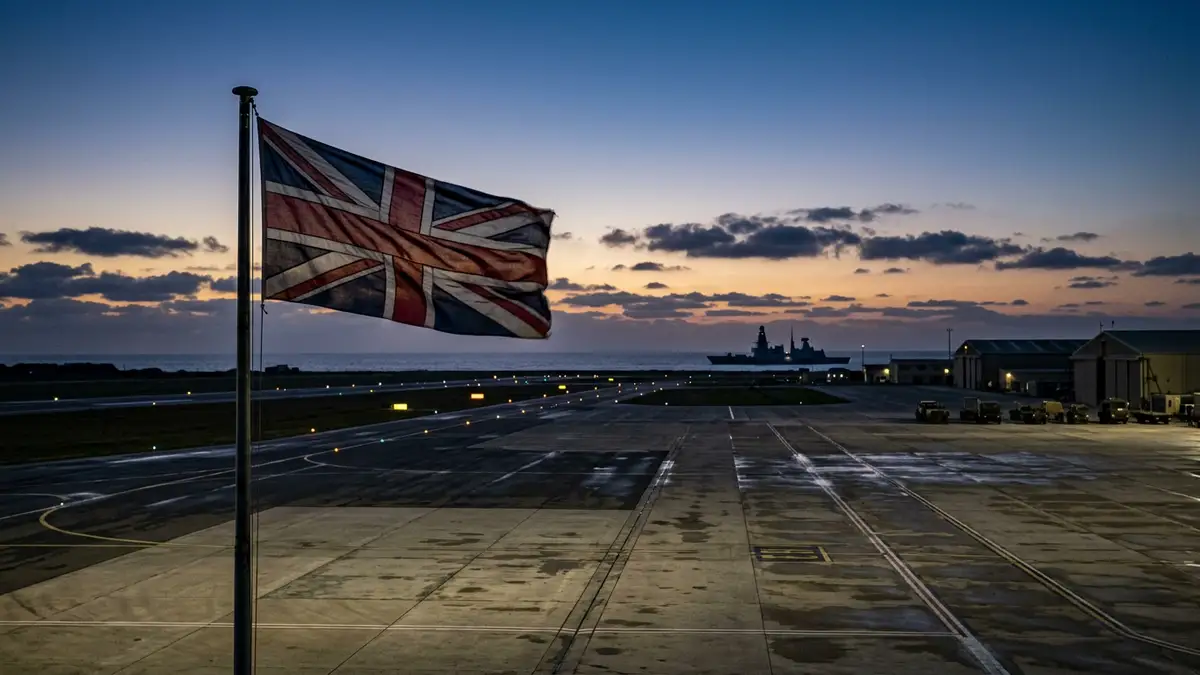
Image: Matt Weston / AI

Callum Smith
The British government has sanctioned the use of UK military bases for American defensive operations after a drone strike targeted RAF Akrotiri in Cyprus.
The explosion at the strategic Mediterranean hub follows a documented pattern of hostility, including previous incursions against British military facilities in Bahrain and Cyprus.
This physical breach of the perimeter fence signals a shift from regional tension to a direct confrontation with British military assets.
In the immediate aftermath of the strike, the British government authorised a United States request to utilise UK military bases for defensive operations against Iranian missile sites.
This decision aligns the two powers in a coordinated effort to neutralise launch platforms before further projectiles reach their targets.
Prime Minister Keir Starmer responded to the breach by ordering the immediate deployment of HMS Dragon to the Cypriot coast.
The Type 45 destroyer will provide a sophisticated air defence umbrella and a visible naval presence to deter further unmanned aerial vehicle (UAV) incursions.
This military mobilisation occurs as the Office for Budget Responsibility confirmed a simultaneous spike in domestic welfare spending.
The resulting fiscal squeeze places the national exchequer under dual pressure from rising defence requirements and internal social obligations.
Inside the House of Commons, the atmosphere turned combative during a heated session of Prime Minister's Questions.
Conservative leader Kemi Badenoch launched a blistering critique of the administration’s strategic posture, accusing the government of failing to project strength.
Weak on Iran, weak on China, weak on our national security.
Badenoch stated that Keir Starmer has been 'weak on Iran, weak on China, weak on our national security.'
She stood at the dispatch box and alleged that 'Iran is trying to kill our servicemen and women' as the conflict expands across the Middle East.
The opposition leader characterised the current strategy as purely reactive rather than preventative.
She claimed the Prime Minister was 'catching arrows rather than stopping the archer' in his refusal to take more aggressive measures.
Furthering her argument, Badenoch insisted the government 'should be doing more' to protect British interests.
She accused Starmer of 'asking our allies to do what we should be doing ourselves' regarding the security of the Mediterranean corridor.
Historical context adds weight to the current crisis, as the geopolitical landscape has shifted significantly since the end of the Cold War.
General Sir Richard Shirreff noted that the United States has signaled it will no longer indefinitely underwrite European security without greater local contribution.
This strategic pivot places the UK in a precarious position as it attempts to balance its role as a global security guarantor with modern budgetary constraints.
The reliance on American defensive support has become a central point of contention in the halls of Westminster.
Former Chancellor Jeremy Hunt joined the chorus of dissent, stating the Prime Minister had 'made a big misjudgement' by restricting the US from using British bases for offensive strikes.
This restriction, according to Hunt, limits the effectiveness of the joint response.
Reform UK leader Nigel Farage described the Prime Minister’s leadership as indecisive during a public address.
The man has dithered, he is all over the place, he is not a leader, he is a follower.
'The man has dithered, he is all over the place, he is not a leader, he is a follower,' Farage stated.
International pressure mounted as Donald Trump weighed in on the UK’s strategic positioning from across the Atlantic.
The former president remarked that 'this is not Winston Churchill that we’re dealing with' in reference to the current Downing Street leadership.
Broadcaster Stephen Dixon characterised the British position in the current war as that of a 'laughing stock' amidst the escalating violence.
His commentary reflects a growing public debate over the UK's perceived loss of influence on the world stage.
Security concerns have now extended beyond the Mediterranean and into the heart of the British political establishment.
This follows the arrest of the partner of a Labour MP on suspicion of spying for China, raising alarms about domestic vulnerability.
The convergence of foreign aggression and domestic espionage has forced an urgent re-evaluation of the UK's integrated review of security, defence, and foreign policy.
Officials are now scrutinising the links between overseas threats and internal subversion.
Military analysts suggest the strike on RAF Akrotiri represents a calculated test of British resolve.
It serves as a probe into the durability of the Anglo-American alliance during a period of heightened regional volatility.
Beyond the immediate tactical response, the arrival of HMS Dragon in Cypriot waters marks the beginning of a reinforced maritime screen.
This screen is specifically designed to intercept and destroy unmanned aerial threats before they reach sovereign soil.
The deployment of the destroyer’s Sea Viper missile system provides a 360-degree defensive perimeter around the base.
This move signals a transition from diplomatic protest to active military fortification in the Eastern Mediterranean.