Iran Deploys 4,000km Range Missiles as US Intercepts Strike on Diego Garcia
Tehran’s expanded arsenal places London and Paris within strike zones as Washington issues a 48-hour ultimatum over the Strait of Hormuz.

Sarah Connor
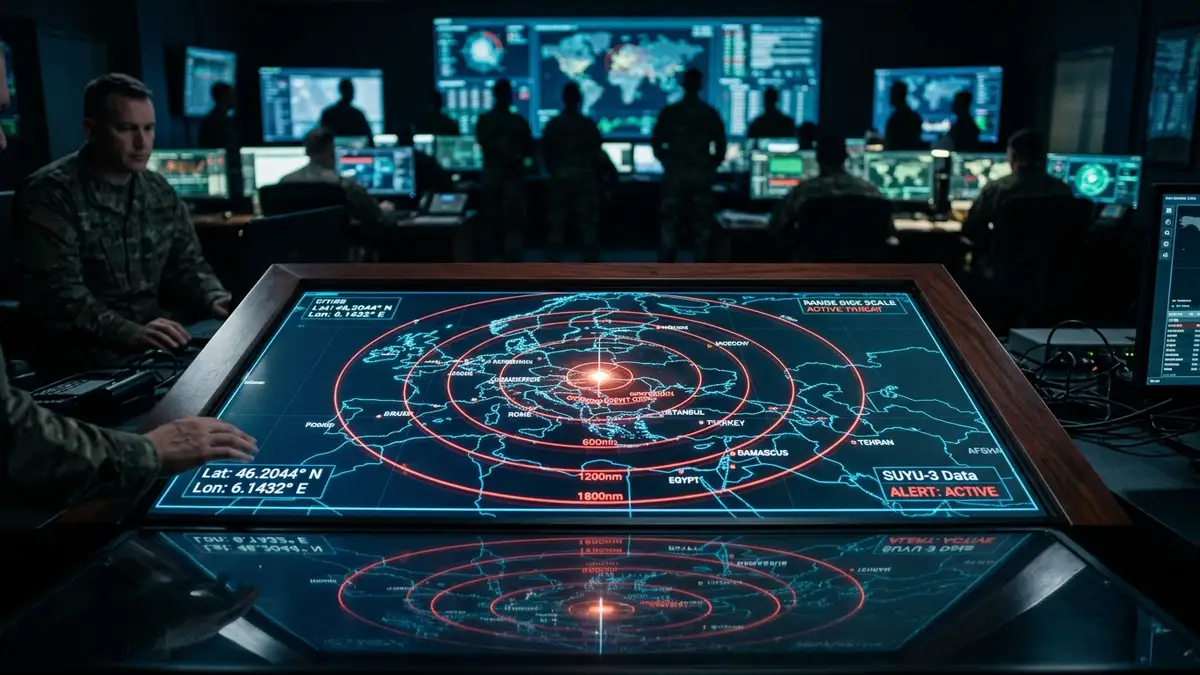
A US naval vessel intercepted an Iranian long-range missile targeting the joint US-UK military base on Diego Garcia, marking a significant escalation in Tehran’s global strike capabilities.
This technological leap places dozens of nations across Europe, Asia, and Africa within a direct strike zone from Iranian launch points.
IDF spokespeople identified the Iranian regime as a global threat, noting that these missiles can now reach major European capitals including London, Paris, and Berlin.
Nawaf Al-Thani stated that Iran has demonstrated a reach far beyond previous global estimates.
The Prime Minister has dithered and delayed on the Iran conflict from the outset.
This assessment marks a change in the recorded reach of Tehran’s ballistic arsenal.
While Paris is now firmly in range, London sits at the edge of vulnerability depending on specific launch coordinates.
The interception at Diego Garcia, a critical logistics hub in the Indian Ocean, confirms the physical expansion of the conflict.
Iranian officials proclaimed they have achieved missile dominance over the skies of occupied territories.
They promised that new tactics would leave the US and Israel astonished.
The UK Ministry of Defence pledged to spend £1 billion over the next six years to bolster homeland air defences.
This funding follows warnings from senior defence figures that the UK currently lacks the capacity to repel a high-level missile assault.
Conservative leader Kemi Badenoch accused Prime Minister Keir Starmer of a cover-up regarding the details of the attack on British troops.
She demanded the Prime Minister explain why the public was not informed of the targeting of the Diego Garcia base sooner.
Badenoch stated that the Prime Minister has dithered and delayed on the Iran conflict from the outset.
She called for immediate transparency regarding the safety of British personnel stationed at the Indian Ocean installation.
US President Donald Trump issued a 48-hour ultimatum for Iran to fully open the Strait of Hormuz without threat.
He stated that failure to comply would result in the US military obliterating Iran’s power plants.
Britain must be ready to fight a technologically advanced war against another state within three years.
The Strait of Hormuz remains the world’s most critical chokepoint for global energy supplies.
Prime Minister Starmer has extended permission for the US to use British bases to launch operations intended to secure the waterway.
Housing Secretary Steve Reed stated that the United Kingdom possesses the systems and defences necessary to keep the nation safe.
He noted that the Prime Minister has remained clear regarding the parameters of the current conflict.
Iran’s atomic agency reported that the Natanz uranium enrichment complex was targeted in a separate attack.
Tehran’s generals responded by warning that tourist destinations anywhere in the world will no longer be safe.
Danny Citrinowicz of the Institute for National Security Studies stated the 4,000km missile range serves as an element of deterrence.
He stated the intent is a demonstration of reach to influence Western policy rather than an immediate attack on London or Paris.
Defence Minister Al Carns stated that Britain must be ready to fight a technologically advanced war against another state within three years.
This timeline aligns with NATO demands for air defence innovation at a scale to match evolving threats.
Former defence officials warned that Iranian-designed drones could be used by proxy actors to hit domestic targets such as Portsmouth.
Tobias Ellwood stated that Britain remains ill-prepared to deal with such low-cost, high-impact saturation scenarios.
Economic pressures from the conflict prompted Lord Richard Walker to ask the government to consider a temporary profit cap on producers and retailers.
He stated this would prevent the exploitation of the crisis to make windfall profits at the expense of consumers.
Cypriot President Nikos Christodoulides stated he will demand negotiations regarding the future of Britain’s military bases on Cyprus.
He characterised the long-standing installations as colonial relics that must be addressed once the war concludes.
Home Secretary Yvette Cooper stated that the UK will not be drawn into a wider conflict despite the provocations.
The government continues to monitor the 4,000km reach of the new Iranian missile systems as they integrate into the regional security landscape.