US Forces Target 5,000 Sites as Hegseth Signals Peak Intensity in Iran Campaign
Operation Epic Fury expands to destroy missile stockpiles and naval assets as President Trump demands unconditional surrender
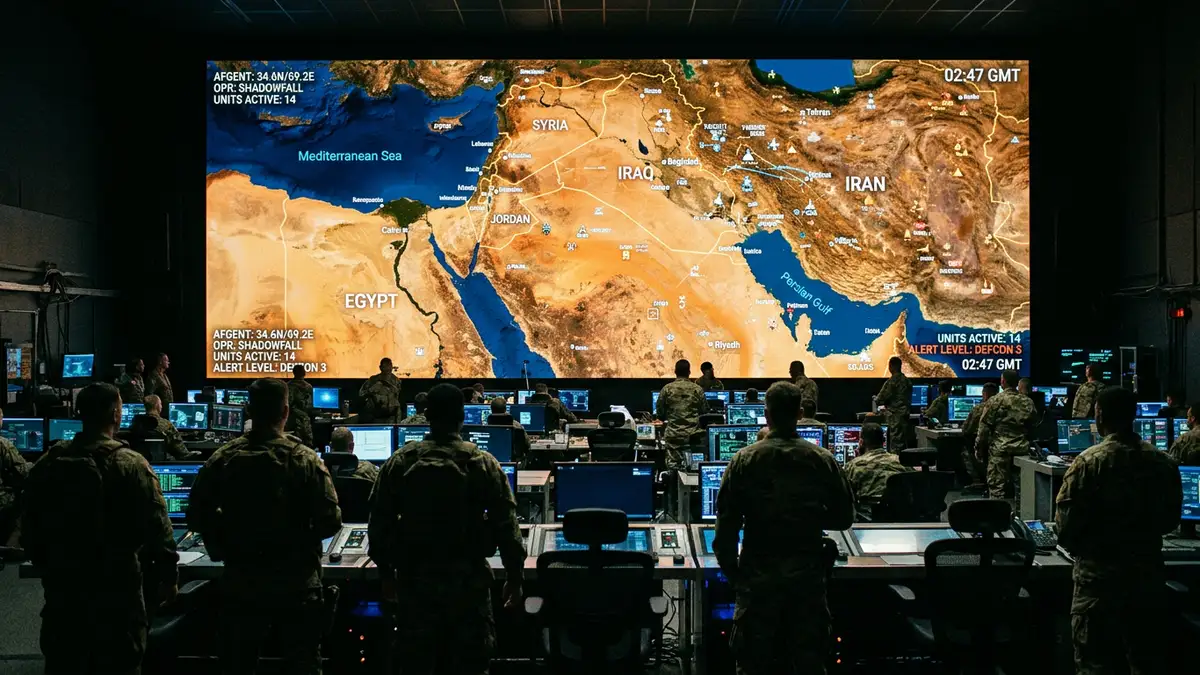
Image: Matt Weston / AI

Callum Smith
President Donald Trump declared the war with Iran will end very soon as American forces launched their most intensive day of aerial strikes to date.
The HMS Dragon, a Type 45 Destroyer, departed Portsmouth for the Eastern Mediterranean to bolster international assets. This naval surge coincides with the arrival of US heavy bombers at RAF Fairford to join the active offensive.
Bahrain reported its first casualty of the conflict as the human and diplomatic costs of the escalation climb. Simultaneously, the Netherlands evacuated its embassy staff from Tehran, relocating the diplomatic mission to Azerbaijan.
Hegseth stated that Iran deliberately embedded military assets within civilian infrastructure to obstruct coalition targeting. He confirmed a strike on the Shajareh Tayyebeh girls’ elementary school after missiles launched from the site on the campaign's first morning.
This kinetic escalation follows a seismic rupture in the regional power structure. On February 28, a US-Israeli operation killed Supreme Leader Ayatollah Ali Khamenei, plunging the nation into a period of intense instability.
US intelligence recently intercepted encrypted communications originating from within Iran following the Supreme Leader’s death. Officials now monitor for the activation of global sleeper cells capable of retaliatory strikes.
President Trump maintains a rigid hardline stance on the diplomatic front. He asserted there would be no deal with the regime short of unconditional surrender.
There would be no deal with the regime short of unconditional surrender.
While Iran expressed a desire for dialogue, Trump clarified that any negotiation remains strictly contingent on his terms. The administration refuses to entertain compromise while the bombardment continues.
In Tehran, Parliament Speaker Mohammad Bagher Qalibaf remains defiant despite the relentless aerial pressure. He stated Iran is not seeking a ceasefire and called for immediate retaliation against all aggressors.
Senior Iranian Security Official Ali Larijani dismissed Washington’s warnings as empty threats. He noted that previous administrations failed to eliminate the Iranian state and predicted the same for the current leadership.
Larijani escalated the personal stakes by threatening the life of President Trump. Hegseth countered by warning the new Supreme Leader, Mojtaba Khamenei, to weigh the consequences of his nuclear ambitions.
The Pentagon is now evaluating a strategic expansion of the conflict toward critical economic nodes. Officials are reviewing plans to seize Kharg Island, the primary hub for Iranian oil exports.
Hegseth declared that US forces are systematically crushing Iran’s military capabilities. He stated that regional proxies, including Hezbollah, the Houthis, and Hamas, are now broken or sidelined.
Regional proxies, including Hezbollah, the Houthis, and Hamas, are now broken or sidelined.
Friedrich Merz interrogated the long-term strategy of the campaign, noting a perceived lack of a unified exit plan. He suggested the US and Israel must align on a path to bring the war to a swift conclusion.
Despite these external critiques, the Pentagon reports that the reduction of Iran's military capacity progresses at a significant pace. High-tempo strikes continue to focus on neutralizing the threat of a nuclear-armed Tehran.
The deployment of the HMS Dragon intensifies the maritime blockade against the regime. Carrier groups and destroyers are now tightening the noose around Iranian interests in the region.
The transition of power to Mojtaba Khamenei remains the primary focus for US intelligence operations. Hegseth emphasized that the new leadership faces a binary choice: total military degradation or a complete nuclear halt.
As the strikes reach peak intensity, the global community monitors the borders of Azerbaijan and the Eastern Mediterranean. The movement of diplomats and the arrival of heavy bombers signal that the campaign has entered its most decisive phase.