Flight Disruptions Strand Thousands as Airspace Closes Over UAE
Iranian strikes and US-Israeli military operations paralyse global transit hubs as 100,000 British citizens face travel chaos
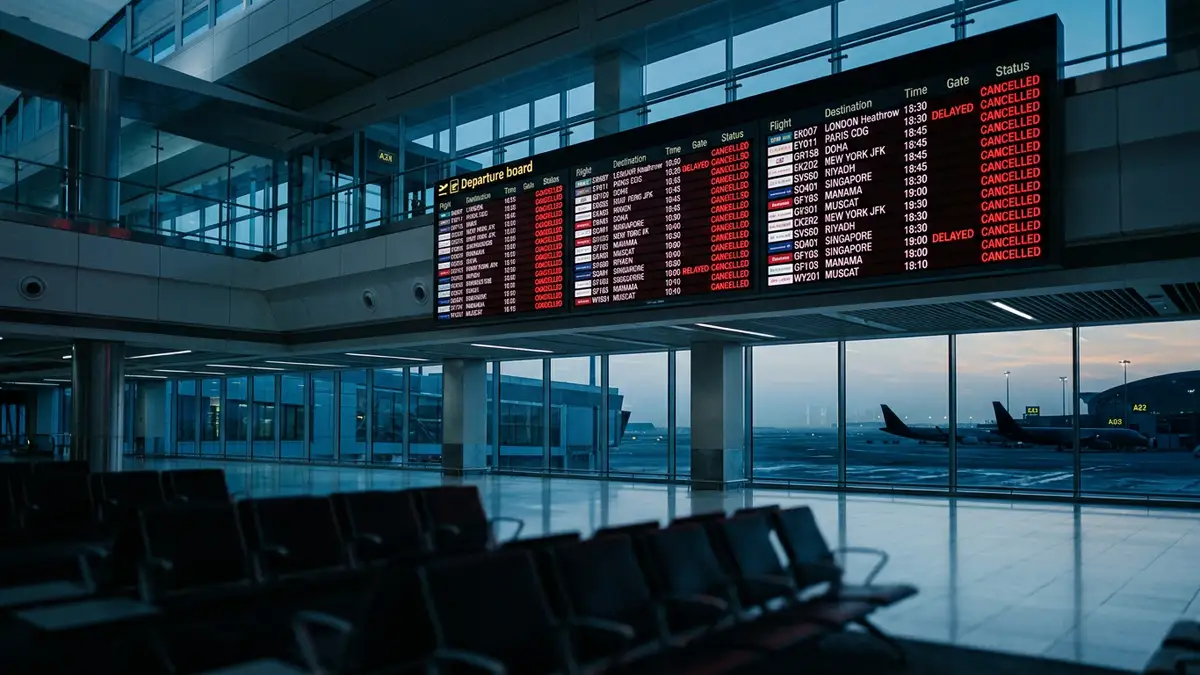
Image: Matt Weston / AI

Callum Smith
Iranian military strikes have triggered the immediate closure of airspace over the United Arab Emirates, leaving an estimated 100,000 British citizens stranded across the Gulf region.
The geography of the war shifted to the Mediterranean as two unmanned drones targeted the RAF base in Akrotiri, Cyprus. The Cypriot government confirmed that defense systems intercepted both aircraft before they reached the facility.
Security protocols at British overseas territories now sit at the highest readiness levels following the Akrotiri interception. This move signals a permanent expansion of the drone threat beyond the Persian Gulf corridor.
Iran issued a formal warning regarding an imminent, high-intensity offensive against United States bases in the region. Military officials track Iranian launch sites for signs of this promised escalation.
United States military operations against Iran could extend far beyond the initial four-to-five-week projection.
President Donald Trump stated that United States military operations against Iran could extend far beyond the initial four-to-five-week projection. This timeline forces a prolonged period of restricted movement for all commercial aviation in the Middle East.
The closure of UAE airspace removes a primary artery for global aviation connecting Europe to Asia. Flight tracking data shows a total cessation of movement through corridors that previously handled hundreds of daily sorties.
Ground crews at Dubai International Airport manage thousands of displaced passengers as terminal capacity reaches its physical limits. Logistics teams prioritize the distribution of food and water to those unable to secure hotel placements.
Airlines including British Airways, Qatar Airways, and Etihad must now reroute passengers on alternative carriers or provide full refunds. These carriers face legal requirements to provide accommodation for travelers caught in transit during the sudden closures.
Emirates announced that passengers may change their ticket dates for travel on or before March 20. The airline also offers full refunds to those who choose not to rebook their flights during the instability.
Direct flights to Singapore and Japan face circuitous detours as carriers avoid active combat zones. Travelers booked with Emirates via Dubai wait for official cancellation notices before seeking alternative transport.
The Foreign, Commonwealth & Development Office (FCDO) reviews travel advice for the entire region. Passengers question if refunds will be issued if flights continue to operate while the FCDO advises against non-essential travel.
Economic analysts point to the rising cost of jet fuel as carriers fly longer routes to bypass the conflict. These operational shifts add several hours to standard flight times for long-haul journeys to the Far East.
The threat to US bases forced a repositioning of naval assets in the surrounding waters to protect strategic interests. This naval movement coincides with the total paralysis of major international transit hubs in Doha and Abu Dhabi.
Travelers remain in holding patterns at airports in London, Doha, and Abu Dhabi as they await updates on airspace safety. Many navigate the complex legal requirements for carrier-provided care under international aviation law.
The Iranian Red Crescent Society continues to update casualty figures as search and rescue operations proceed in the 130 affected cities. The scale of the urban damage hampers the movement of emergency personnel.
Airlines have not yet provided a definitive timeline for the resumption of standard flight paths. The situation remains dictated by the duration of the US-Israeli military campaign and the scale of the Iranian response.
The threat of a sustained offensive forces commercial carriers to treat the region as a permanent no-fly zone. This shift represents one of the most significant disruptions to global air travel since the 2003 invasion of Iraq.
As the US military prepares for long-term engagement, the economic impact on the UAE's aviation sector continues to mount. The total cessation of flights through Dubai threatens the stability of the global supply chain between East and West.