Crude Oil Surges Past $100 as Middle East Conflict Threatens UK Economy
Chancellor Rachel Reeves warns of inflationary pressure while economists signal a potential recession risk surpassing the 1973 oil embargo.
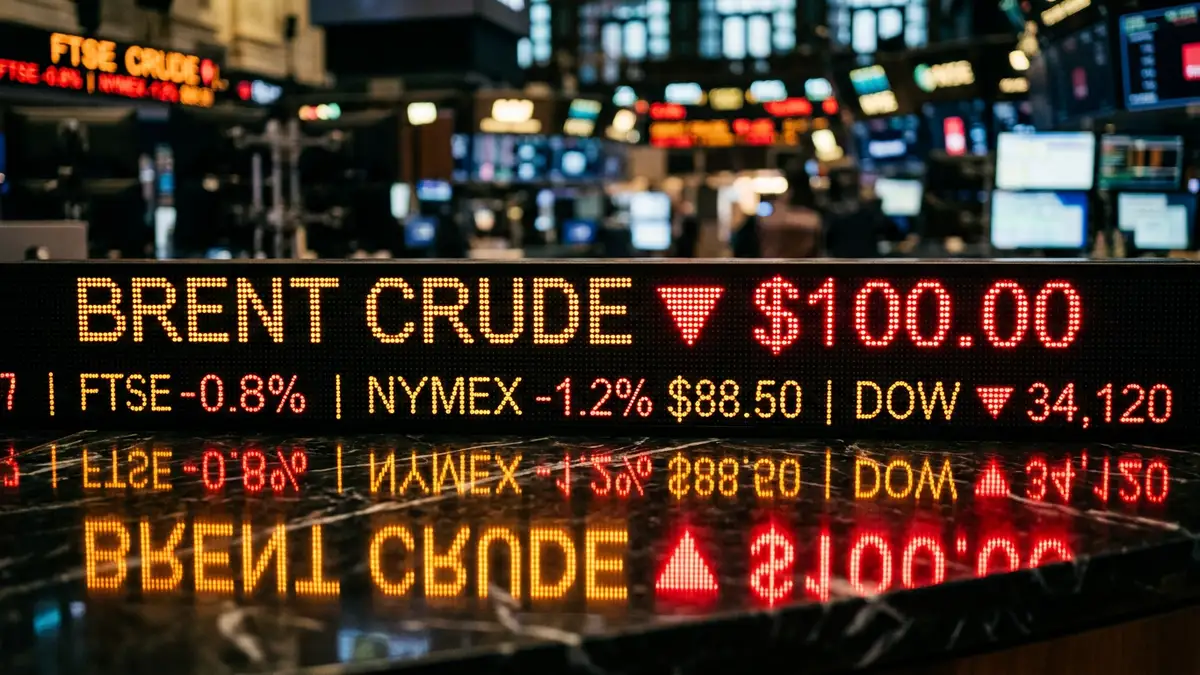
Image: Matt Weston / AI

Sarah Connor
Brent crude oil prices breached the $100 per barrel threshold as escalating hostilities in the Middle East triggered a sharp sell-off across the FTSE 100 and global energy markets.
Economic warnings have sharpened as the conflict persists. Economist Tyler Goodspeed stated that the energy supply crisis in the Persian Gulf threatens to push both Britain and America into a deep recession.
This projected downturn could surpass the 1973 oil embargo. That shock fundamentally restructured the mechanics of global trade for a decade.
Britain faces a higher level of exposure to this crisis than either the United States or continental Europe.
Goodspeed asserted that Britain faces a higher level of exposure to this crisis than either the United States or continental Europe. He attributed this vulnerability to a reversal of energy patterns and a sustained increase in government spending.
Historically, the United Kingdom shifted its energy profile heavily toward gas consumption. Simultaneously, the state halted the conditions necessary for North Sea exploration.
This policy trajectory leaves the domestic market reliant on international supply chains. Sovereign production has stalled in favor of a dependence on global pipelines.
Prime Minister Sir Keir Starmer cautioned that a protracted war in the Middle East will result in tangible economic damage within the UK. He stated that the impact would reach the households of every business across the country.
In the energy sector, Energy Secretary Ed Miliband declared that the government will not tolerate price gouging as fuel costs climb. He issued this warning as average petrol and diesel prices reached new highs over the past seven days.
RAC head of policy Simon Williams described the current landscape for UK motorists as increasingly bleak. He confirmed that pump prices are continuing their ascent as the regional conflict persists.
Political friction intensified as Sir Mel Stride challenged the government's fiscal preparations. He argued that the Chancellor's management has left the country more vulnerable to energy spikes.
Stride questioned whether the current administration had established sufficient buffers to protect the economy. He pressed for evidence of a strategy that could withstand the current market volatility.
The crisis has the potential to bring down entire economies if supply remains constrained.
International stakeholders have issued warnings regarding the global supply chain. Saad al-Kaabi, the energy minister for Qatar, stated that the crisis has the potential to bring down entire economies if supply remains constrained.
Former Goldman Sachs chief Lloyd Blankfein noted that markets are ignoring hidden risks that could destabilise international finance. He pointed to the lack of liquidity in current trading sessions.
On the domestic front, Steve Webb, a partner at pension consultants LCP, identified older and poorer pensioners as the demographic most at risk. These individuals remain the most exposed to fluctuations in the costs of domestic heating.
Criticism also targeted the nation's military readiness during this period of instability. Quentin Letts directed critiques at the Ministry of Defence, specifically citing the Royal Navy for a lack of performance during the opening stages of the crisis.
He attributed the current state of naval unreadiness to the cumulative decisions of previous Conservative governments. This lack of maritime agility restricts the UK's ability to project power in the region.
Chancellor Reeves told the Commons that her policies were designed to strengthen national infrastructure. She insisted that her department has prioritised growth and increased financial buffers to mitigate international shocks.
Tyler Goodspeed observed that while a quick resolution to the conflict is possible, a protracted engagement remains the more probable scenario. He warned that sustained high energy prices would leave the Starmer administration exposed to public discontent.
Industry experts indicated that the timeline for a significant economic contraction is accelerating as Brent crude remains above $100. The government is now monitoring the secondary inflationary impact on the cost of essential goods.
The FTSE 100 continues to reflect this instability, with major indices showing a sustained downward trend. This market movement coincides with the highest energy price volatility seen in the current decade.