Stranded British Nationals Face Mass Flight Cancellations Amid Escalating Iran-Israel Conflict
Military assets deploy to Qatar and Cyprus as technical failures ground government-chartered evacuation efforts in Oman
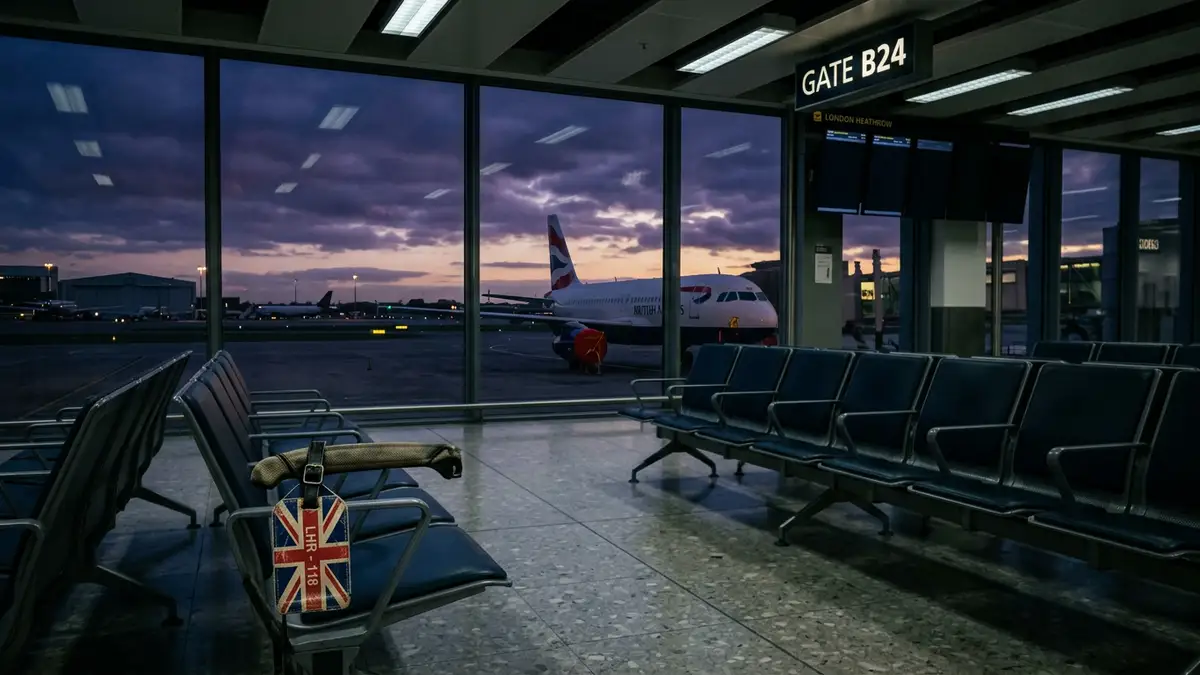
Image: Matt Weston / AI

Callum Smith
A critical failure in the UK government’s emergency evacuation strategy has left thousands of British nationals trapped across the Middle East as the military confrontation between Israel and Iran enters its sixth day of sustained kinetic strikes.
Witnesses at the terminal witnessed escalating chaos. Passengers suffered panic attacks and struck windows during the prolonged delay.
One evacuee denounced the operation as a total failure. Consular staff provided no assistance as the terminal environment turned volatile.
A total failure.
The rescue route required a complex journey from Muscat to London Stansted with a mandatory refueling stop in Cairo. British Airways introduced a fourth daily flight from Muscat to London Heathrow to provide an alternative for those with the means to rebook.
Prime Minister Sir Keir Starmer confirmed that 1,000 British nationals returned on commercial routes. However, the scale of the remaining population remains staggering.
Three hundred thousand people remain stuck in the Gulf. Of those, 140,000 individuals officially registered their presence with the Foreign Office.
British F-35s and Typhoon fighter jets conduct defensive sorties out of Cyprus. These assets protect regional interests against a backdrop of increasing aerial incursions.
The Ministry of Defence is deploying four additional Typhoon jets to Qatar. Simultaneously, the HMS Dragon, a Type 45 destroyer, steams toward the Mediterranean to provide advanced air defense.
This naval and aerial surge follows a direct ballistic missile strike on the Al-Udeid US airbase and the systematic targeting of Hamad airport. Iranian state television broadcast claims on Thursday morning that a fresh wave of attacks hit both Israeli and American military installations.
Israel launched heavy strikes against critical infrastructure in Tehran as air sirens wailed across Tel Aviv and Jerusalem. Explosions tore through southern Beirut during a targeted Israeli air raid on a known Hezbollah stronghold.
Maritime security has collapsed. Iran's Revolutionary Guards claimed a direct hit on a US tanker in the northern Gulf, leaving the vessel engulfed in flames.
The Iranian foreign minister escalated the rhetoric by accusing the United States of striking an Iranian frigate in international waters. He vowed that Washington would bitterly regret the provocation.
Washington would bitterly regret the provocation.
Cyprus officials publicly criticized the lethality and speed of the British naval response. Kyriacos Kouros pointed out that while Greek and French forces arrived with anti-drone systems, the British warship will not arrive until next week.
Shadow Secretary Kemi Badenoch noted that regional partners including Bahrain, Kuwait, and the UAE now openly question the UK's strategic posture. She highlighted that the government in Cyprus feels abandoned by the UK during this period of maximum escalation.
Foreign Secretary Yvette Cooper maintained that the safety of British citizens remains the absolute priority. She acknowledged the unprecedented scope of the crisis, noting that hundreds of thousands of lives are currently disrupted by the regional gridlock.
The government is coordinating with Jewish and Muslim community leaders to implement enhanced protective security measures. Starmer announced these safeguards alongside a strategy to defend UK energy infrastructure from Iranian targeting of oil and gas facilities.
Internal timelines reveal a disconnect in the command structure. One Western official stated the proposal to deploy a warship did not reach the chief of defense staff until Tuesday morning.
This delay placed the decision ninety-six hours after the initial outbreak of hostilities. It occurred forty hours after a drone struck RAF Akrotiri.
Foreign Secretary David Lammy defended the timing, stating the UK conducted a rigorous assessment to avoid placing soldiers in offensive roles without a clear legal threshold. He observed that the United States had opted for a more aggressive military path.
Commercial aviation has effectively ceased in the heart of the conflict zone. Qatar Airways suspended the majority of its operations following the closure of Qatari airspace.
The carrier is restricted to a handful of relief flights to European hubs as the skies remain contested. Authorities at Dubai Airports issued an emergency directive telling passengers to stay away from terminals unless they hold a confirmed departure slot.
The arrivals hall at Heathrow Airport sat empty in the early hours of Thursday as the regional shutdown took full effect. This silence followed the total cessation of standard commercial traffic from the region.
Starmer compared the logistical burden of this evacuation to the 2021 airlift from Afghanistan. He warned that the current conflict in the Middle East shows no signs of immediate resolution and could persist for an indefinite period.