Trump and Netanyahu Launch Pre-emptive Strikes Against Iranian Military Infrastructure
The United States and Israel deploy a massive naval armada to the Middle East as the White House calls for the overthrow of the Islamic regime.
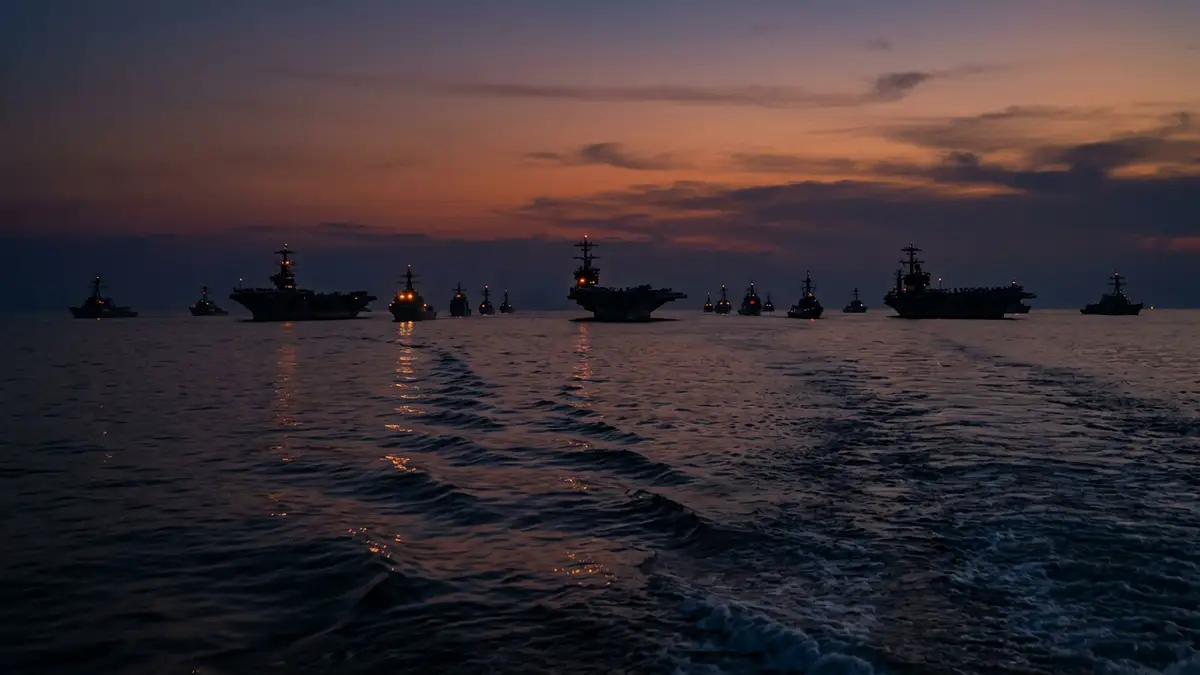
Image: Matt Weston / AI

Sarah Connor
President Donald Trump has authorized a joint military offensive with Israel to dismantle the Iranian nuclear program and neutralize the Islamic Revolutionary Guards Corps.
The United States military anchors a massive naval armada in the Middle East to support active combat operations. This deployment marks the highest level of American military involvement abroad in recent memory.
President Trump confirmed the Tehran government sits within one week of obtaining sufficient material for a nuclear threat. He identified Iran as a primary source of global danger that refuses to renounce its pursuit of atomic weapons.
The hour of freedom has arrived.
The campaign targets Iran's ballistic missile stockpiles, the Islamic Revolutionary Guards Corps (IRGC), and various proxy forces. Trump moves to eliminate all remaining nuclear facilities to prevent the regime from acquiring a functional weapon.
Benjamin Netanyahu declared this war offers the Iranian people a specific opportunity to overthrow their current government. He has maintained for decades that the Islamic regime constitutes the primary threat to Israeli security.
Addressing the Iranian public directly, Trump announced that the hour of freedom has arrived. He openly encourages a domestic uprising to replace the clerical leadership in Tehran with a new administration.
The Pentagon warns that a prolonged air campaign carries volatile risks for the broader region. However, General Dan Caine stated that the military would win the conflict easily at a tactical level.
The military would win the conflict easily at a tactical level.
White House officials signaled a strategic preference for Israel to lead the initial wave of strikes. This positioning anticipates that Iranian retaliation against U.S. assets would provide the justification for expanded American action.
Iran vowed to retaliate with maximum force against the joint offensive. The IRGC mobilizes to close the Strait of Hormuz, utilizing Houthi rebels to choke global shipping lanes.
The Iranian regime murdered thousands of its own citizens this year while using weaponized religion to destabilize Lebanon through Hezbollah. Michael Burleigh concluded that Netanyahu and Trump calculate the regime is now weak enough to topple.
David Ignatius described the president’s strategy as a Viking playbook. This doctrine involves massive, overwhelming military action followed by a rapid withdrawal, leaving the local population to manage the wreckage.
Joe Scarborough noted that Trump vowed to take direct action where previous presidents hesitated. This shift follows Trump’s claims that former President Obama would only start a war with Iran to distract from political faults.
The regional landscape shifted as Saudi Arabia evaluates whether it must become a nuclear power in response to the instability. Simultaneously, Trump seized control over Venezuela’s oil revenues by arresting its president in Caracas.
Indirect diplomatic channels remain open between the U.S. and Iran in Geneva despite the kinetic conflict. The parties scheduled a meeting in Vienna to discuss the escalating crisis and potential de-escalation terms.
Domestic political figures in the United States offer conflicting views on the necessity of the conflict. Stephen Miller claimed a vote for Kamala Harris leads to World War III, while Tulsi Gabbard argued a vote for Trump ends wars.
Citizens across the Middle East received instructions to take cover from expected Iranian airstrikes as the conflict expands. The strikes triggered a violent backlash and increased threats of international terrorism across multiple continents.
The president previously declared the Iranian nuclear program obliterated during his first term in office. He now maintains that this military action provides the only definitive way to ensure the regime never acquires a weapon of mass destruction.