Global Aviation Halts as US and Israel Launch Joint Military Strikes on Iran
Airlines reroute across three continents while explosions rock Tehran and regional missile interceptions trigger a total airspace collapse.
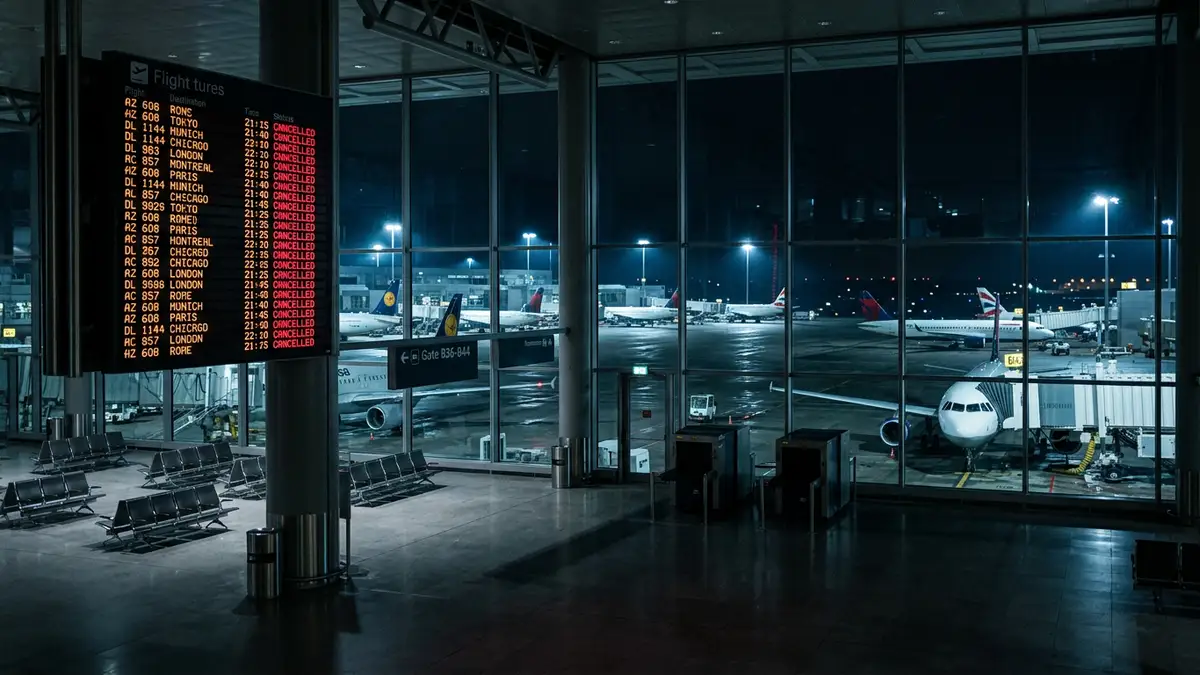
Image: Matt Weston / AI

Sarah Connor
Major global airlines halted and rerouted services across the Middle East on February 28, 2026, as Israel and the United States commenced joint military action inside Iran.
Explosions and heavy smoke erupted over Tehran and multiple Iranian cities as the joint operation commenced. The Israeli government confirmed the strikes while the United States military hit additional targets throughout the country.
The commercial aviation sector collapsed as IndiGo, Qatar Airways, and PIA grounded all Middle East flights on Saturday. Lufthansa suspended operations to and from regional destinations immediately following the initial bombardment.
Israeli authorities closed the nation's airspace as the military operation began. The Foreign Office updated its travel advice to warn against all movement into Israel and Palestine.
Iran’s Revolutionary Guard launched a first wave of drones and missiles targeting Israeli territory. This followed the Guard's accusations that the U.S. utilized regional facilities to conduct the initial strikes.
The Tasnim News Agency stated that Iran is striking American bases and interests across the region. Footage from the escalation shows a U.S. facility in Bahrain taking a direct hit.
Benjamin Netanyahu stated the joint attack with the U.S. aimed to remove an existential threat posed by Iran. The Israeli Prime Minister added that Iranians could now take their fate into their own hands.
Iranians could now take their fate into their own hands.
Israel issued a nationwide warning after reports indicated Iran launched ballistic missiles in response to the strikes. Qatar's defense ministry confirmed its batteries intercepted Iranian missiles over its territory.
The UAE reported the interception of Iranian missiles over its own airspace. Donald Trump stated in a social media video that the U.S. had begun major combat operations in Iran.
The scale of the engagement forced immediate changes to international flight corridors. Extended flight paths and air traffic control congestion will disrupt travel until the regional airspace reopens.
An airport spokesperson stated the current restrictions will last into Sunday. Historical flight data shows this disruption follows a period of escalating regional friction.
The sudden closure of these corridors forces carriers to utilize longer routes over Africa or Central Asia. Economic pressure on the aviation industry mounted as fuel costs for rerouted flights began to climb.
Stakeholders in the global logistics sector are monitoring the security of transit hubs in Doha and Dubai. Passengers abandoned routes through the Persian Gulf as travel patterns shifted away from the combat zone.
The current military landscape dictates a prolonged period of instability for commercial transit in the Middle East. This shift mirrors the 1967 Six-Day War when the Suez Canal closure forced global shipping to circumnavigate Africa.
Aviation analysts note that the 2026 closure of Iranian and Israeli airspace removes a primary artery for Europe-to-Asia transit. This forces a reliance on the Baku and Tashkent corridors, which are already nearing capacity.
Political pressure is mounting on the U.S. Department of State as regional allies face the brunt of retaliatory fire. The interceptions over Doha and Abu Dhabi mark a significant expansion of the combat zone into neutral commercial hubs.
Energy markets reacted to the strikes with immediate volatility as the Strait of Hormuz remains under threat. Logistics firms are pricing in a 15 to 20 percent increase in operational costs due to the extended flight times.
The Revolutionary Guard continues to signal that its missile batteries remain operational despite the initial wave of U.S. strikes. Military analysts state the conflict has moved into a phase of sustained kinetic exchange.
The U.S. had begun major combat operations in Iran.
Commercial passengers stranded in Istanbul and Mumbai face indefinite delays as airlines struggle to reassign crews. The International Air Transport Association has not yet issued a timeline for a return to normalcy.
The Pentagon has not released a casualty count for the facility hit in Bahrain. Ground observers in Tehran report that anti-aircraft fire continues to illuminate the skyline as the second wave of strikes begins.