US and Israeli Forces Launch Massive Offensive Against Iran Amid Reports of Khamenei’s Death
Joint military strikes target Tehran leadership compounds as regional powers brace for a shift in the theocratic order
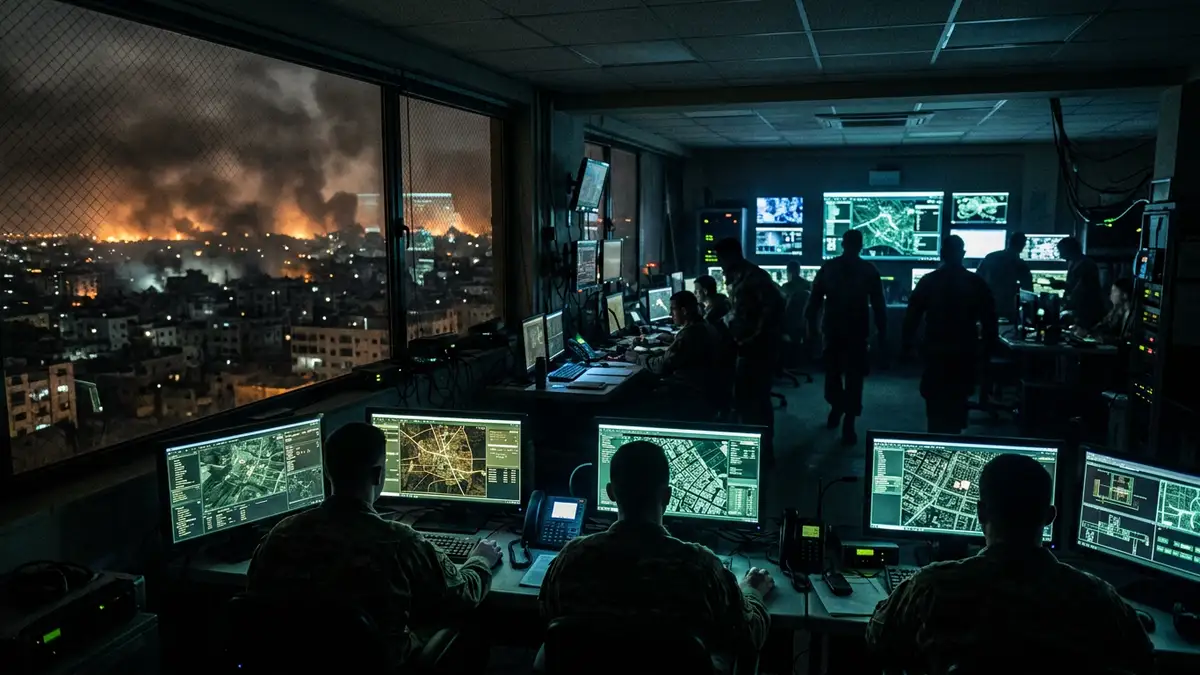
Image: Matt Weston / AI

Callum Smith
United States and Israeli forces initiated a massive joint military offensive against Iran on Saturday morning, striking high-level leadership compounds and military infrastructure across the country.
Israeli Prime Minister Benjamin Netanyahu stated that intelligence indicators suggest Supreme Leader Ayatollah Ali Khamenei is no longer present.
Netanyahu asserted that the long-standing plan to destroy Israel has effectively vanished alongside the high likelihood that the tyrant Khamenei has been eliminated.
The long-standing plan to destroy Israel has effectively vanished alongside the high likelihood that the tyrant Khamenei has been eliminated.
The primary kinetic focus centered on Khamenei’s residence in central Tehran, which now sits in a state of total structural ruin.
While Iranian Foreign Minister Abbas Araghchi claimed the Supreme Leader survived the onslaught, Israeli officials reported the recovery of his body from the smoking debris.
The Israeli Defense Forces confirmed that hundreds of high-value targets were shattered in multiple, successive waves of aerial bombardment.
These strikes prioritised locations where senior political and security figures had congregated at the precise moment of impact.
Beyond the destruction of the residence, IRGC commander General Mohammad Pakpour and Defense Minister Amir Nasirzadeh died in the strikes.
Donald Trump reinforced this assessment, confirming the U.S. belief that the reports of Khamenei's death are accurate.
Historically, the Islamic Republic has functioned through the absolute central authority of the Supreme Leader since the 1979 Revolution.
This sudden removal of the regime's ideological pillar creates a power vacuum unseen in four decades of Iranian history.
Iranian state media countered the military narrative by reporting a heavy civilian toll, claiming at least 201 people have been killed across the country.
The IRNA news agency reported that 40 girls died and 45 others were wounded when a strike impacted a school near a military site.
In southern Iran, the Tasnim news agency reported that a primary school for girls in Minab was struck, resulting in 85 confirmed deaths.
Despite the mounting evidence of chaos, the Iranian Foreign Ministry’s spokesman maintained that both Khamenei and President Masoud Pezeshkian remained safe.
The regional escalation widened as Iranian forces launched counter-strikes against American and allied assets in Bahrain, Kuwait, Qatar, Jordan, and the UAE.
The UAE's state news agency confirmed one death after Iranian missiles were intercepted over its sovereign territory.
In Bahrain, the National Communication Centre reported that the service centre for the US Navy's Fifth Fleet in Manama took a direct missile hit.
Meanwhile, Kuwaiti air defence forces successfully intercepted ballistic missiles targeting the Ali Al-Salem airbase.
Jordanian armed forces reported the destruction of two ballistic missiles that breached their airspace during the height of the exchange.
The U.S. military reported no American casualties and only minimal infrastructure damage at its regional bases despite hundreds of Iranian drone attacks.
This preemptive action followed a period of intense monitoring by the Israeli Defense Forces.
Lt. Col. Nadav Shoshani stated that Israel had identified a sharp acceleration in Iran's missile program, with factories producing dozens of ballistic missiles per month.
Israel had identified a sharp acceleration in Iran's missile program, with factories producing dozens of ballistic missiles per month.
Internal Iranian opposition movements have moved with speed to fill the perceived power vacuum.
Maryam Rajavi declared a provisional government and unveiled a 10-point plan intended to steer the nation's future away from theocratic rule.
In the streets of Tehran, witnesses reported residents cheering and honking horns in celebration following the news of the Supreme Leader's demise.
Conversely, the head of public relations at the Supreme Leader's office dismissed these reports as psychological warfare orchestrated by the enemy.
Militia groups across the region have signaled a prolonged conflict following the decapitation of the IRGC leadership.
Kataib Hezbollah urged its fighters to prepare for a war of attrition and warned the Kurdish regional government against collaborating with foreign forces.
The violence has spilled across multiple national boundaries, with Iraqi officials reporting two deaths from a drone strike within their borders.
Syrian state television reported four people killed by an Iranian missile as the regional security architecture buckled.
European leaders have convened emergency security meetings to address the rapidly shifting landscape in the Middle East.
The collapse of the established order in the Persian Gulf has forced immediate and urgent diplomatic reassessments in London and Paris.
The Israeli military thinktank Alma reported that Iran had launched 25 waves of attacks by late afternoon.
The IDF maintains that the operation has inflicted very significant harm on Iran’s senior leadership and top military commanders.
The future of the Iranian state remains suspended as theocratic loyalists and opposition groups vie for control of the streets.
This shift marks the most significant geopolitical realignment in the region since the start of the century.