Air Canada Express Flight Collides with Fire Engine at LaGuardia Airport
A CRJ-900 aircraft struck a ground vehicle on Runway 4, leaving four firefighters in critical condition and forcing a total facility closure.
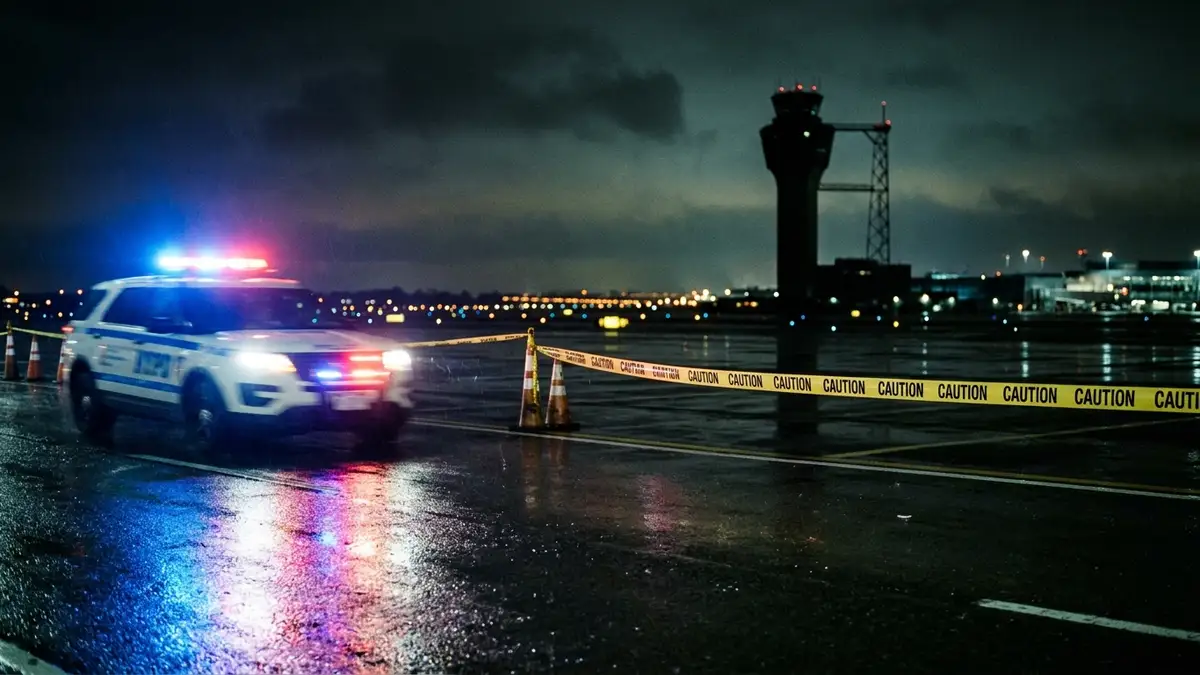
Image: Matt Weston / AI

Sarah Connor
An Air Canada Express CRJ-900 aircraft collided with a fire engine at LaGuardia Airport late Sunday night, triggering a mass casualty response and an immediate ground stop at the major New York transport hub.
The aircraft, operated by Jazz Aviation, executed its final approach from Montreal with 80 passengers on board before the collision. At 11:37 p.m., the jet crossed Runway 4 within the Delta terminal perimeter.
Flight data recorders show the aircraft maintained a speed of 24 mph at the moment of impact. The force of the strike mangled the fire engine's steel frame and tore a jagged hole through the aircraft’s pressurized skin.
Emergency responders confirmed four firefighters remain in critical condition at local trauma centers. Sixty individuals sustained injuries as the metal-on-metal impact threw passengers against the cabin interior.
The pilot and co-pilot of the Air Canada Express flight suffered the most severe trauma among those on the aircraft. The fire engine struck the forward cockpit section directly, crushing the flight deck controls and floorboards.
The Federal Aviation Administration (FAA) responded by freezing all traffic at LaGuardia with an immediate ground stop. The airport remains shuttered until at least 2 p.m. Monday while forensic teams sweep the tarmac.
The National Transportation Safety Board (NTSB) launched a formal investigation into the mechanics of the runway incursion. Investigators are currently mapping the coordinates where the jet and the truck intersected on Runway 04/22.
This collision occurs at a facility defined by its 680-acre footprint, the smallest major airport landmass in the United States. LaGuardia’s intersecting runways and narrow taxiway bottlenecks have historically forced controllers to manage movements within inches of safety margins.
The incident adds immediate pressure to a domestic aviation system already strained by a 15% increase in near-miss reports over the last fiscal year. A Department of Homeland Security funding standoff has simultaneously frozen the hiring of 2,000 new air traffic controller candidates.
If the Democrats do not allow for Just and Proper Security at our Airports, and elsewhere throughout our Country, ICE will do the job far better than ever done before!
Donald Trump addressed the security situation following the crash, linking the safety of transport hubs to ongoing federal budget disputes. 'If the Democrats do not allow for Just and Proper Security at our Airports, and elsewhere throughout our Country, ICE will do the job far better than ever done before!' he stated.
Trump indicated he has instructed Immigration and Customs Enforcement (ICE) to prepare for a shift in operational responsibilities. He suggested the agency could assume control of national security infrastructure as early as this week.
I look forward to moving ICE in on Monday, and have already told them to, ‘GET READY.’ NO MORE WAITING, NO MORE GAMES!
'I look forward to moving ICE in on Monday, and have already told them to, “GET READY.” NO MORE WAITING, NO MORE GAMES!' Trump said. These directives signal a shift in the federal management of perimeters at major transit points.
Airlines have already scrubbed hundreds of flights from the Monday morning schedule. Passengers at the Delta terminal faced shuttered gates and the sight of heavy recovery cranes lifting debris from the Runway 4 intersection.
The economic impact of the 14-hour closure ripples through the Northeast Corridor. Connecting hubs in Chicago, Atlanta, and Toronto report delays affecting over 45,000 travelers due to the LaGuardia bottleneck.
Industry stakeholders are now scrutinizing the radio frequency logs between the control tower and ground support vehicles. The NTSB is reviewing the exact timestamp of the fire engine’s clearance to enter the active taxiway.
The Jazz Aviation CRJ-900 remains stationary on the tarmac as structural engineers work to stabilize the airframe. Recovery teams must hoist the wreckage onto flatbed trailers to prevent further gouging of the runway surface.
Hospitals in Queens and Manhattan remain on high alert, processing a steady stream of injured passengers and flight crew. The medical status of the four firefighters remains the primary focus for emergency services leadership on the scene.
Future safety mandates may require high-intensity strobe lighting for all ground support equipment during night operations. This collision provides a concrete data point on the risks of complex ground movements during peak night-shift hours.
The NTSB will hold the flight data recorders at their Washington D.C. laboratory for a full digital reconstruction of the final seconds. Until the wreckage is cleared, the Delta terminal remains a dead zone of stalled machinery and empty jet bridges.