Israel and United States Launch Joint Strike Against Iran as Missile Hits Dubai Hotel
Regional aviation grinds to a halt as kinetic engagement shifts from military installations to civilian infrastructure in the United Arab Emirates
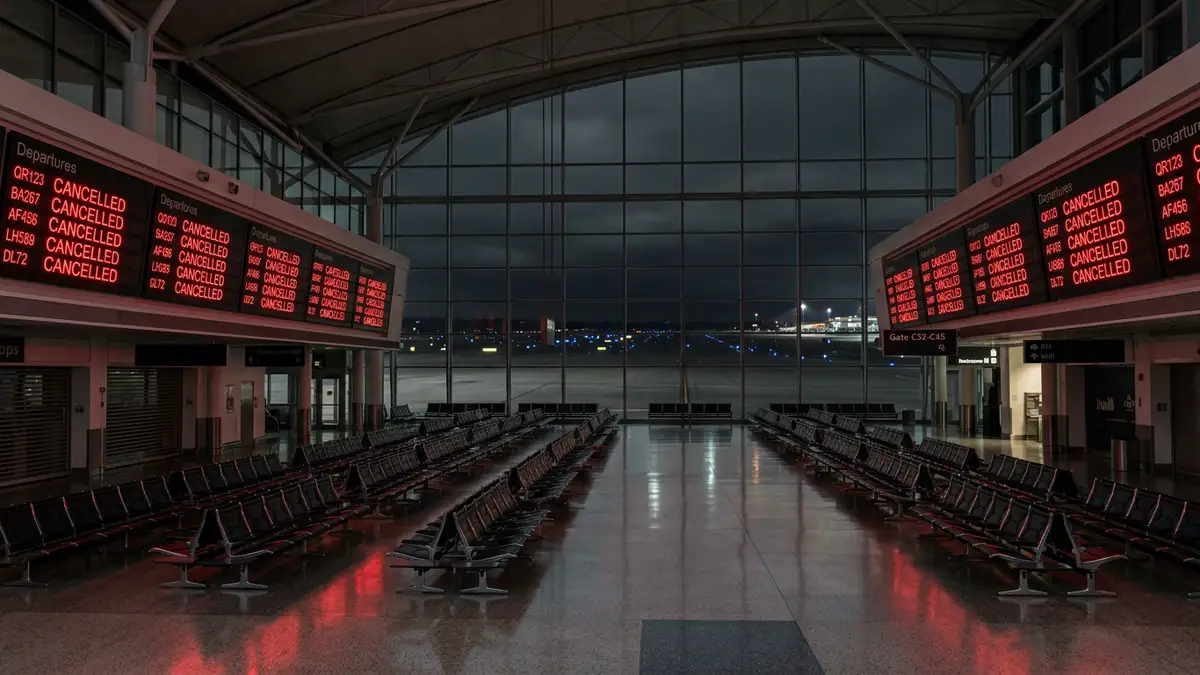
Image: Matt Weston / AI

Callum Smith
A coordinated military offensive by Israel and the United States against Iran on Friday triggered a total suspension of global aviation hubs and left four staff members injured at a five-star hotel in Dubai.
A missile struck a five-star hotel in Dubai during the exchange, shearing concrete from the luxury property's facade. Witnesses reported the building shuddered under the force of the explosion as the projectile impacted the upper tiers.
Charlotte Butler stated her hotel room shook violently while she prepared to leave for the evening. Witness Steve Penk reported the distinct whistle of the approaching missile seconds before the detonation at the hotel site.
This regional aviation shutdown follows the precedent of the 2020 closure of Iranian airspace after the downing of Ukraine International Airlines Flight 752. That event resulted in 176 fatalities and a multi-day suspension of all commercial traffic in the region.
Current flight data indicates the grounding directly affects Emirates, Qatar Airways, and El Al. These three carriers manage a combined fleet of over 500 wide-body aircraft through these specific primary hubs.
The United States Department of Defense and the Israeli Ministry of Defense withheld the specific number of assets deployed in the Friday strike. This silence aligns with the protocol for high-security operations conducted within the contested region.
Economic pressure mounted as oil markets reacted to the potential closure of the Strait of Hormuz corridor. This maritime passage remains a critical artery for global energy supplies and now faces direct threats from the escalating hostilities.
Dubai processed 87 million passengers through its airport last year and now faces a total halt in its tourism operations. The economic fallout for the United Arab Emirates remains unquantified as the impact zone remains cordoned off by security forces.
Katy McKinney described the aftermath as the result of a drone or a missile intercepted directly over the city. Debris from the mid-air engagement fell across multiple districts, creating hazards for civilians on the ground.
One individual exited an Irish pub after being informed that missile debris had landed on a nearby hotel. An influencer positioned meters from the strike site documented the immediate physical damage to the urban landscape via mobile video.
In this situation there is nothing a parent can do for their children.
Mark, a parent at the scene, stated that in this situation there is nothing a parent can do for their children. He described a total lack of agency as the kinetic event unfolded in the civilian-populated area.
The Foreign Office instructed British nationals in the region to follow all directives issued by local authorities. Citizens must monitor official travel updates as the security situation continues to evolve.
The strike on a Dubai hotel moves the geography of the conflict into international commercial centers. Previous engagements between these powers remained largely confined to military installations in rural provinces.
Regional security forces established a perimeter around the impact zone to assess the structural integrity of the hotel property. Emergency crews remain on-site to treat the four injured airport staff members caught in the blast radius.
The suspension of flights in Doha and Tel Aviv remains indefinite as military officials refuse to provide a timeline for the cessation of hostilities. Sovereign airspace remains closed to all non-military traffic until further notice.
Ground crews at Dubai International Airport reported the immediate redirection of over forty inbound long-haul flights to secondary strips in Oman and Saudi Arabia. This logistical pivot forced thousands of travelers into makeshift holding areas as terminal services reached maximum capacity.
The Dubai Financial Market saw a sharp contraction in real estate and tourism stocks within sixty minutes of the hotel strike. Analysts tracked a 4.2 percent dip in the general index as the physical security of the city's infrastructure came under question.
Military analysts identified the debris as consistent with high-velocity interceptor missiles used in regional defense batteries. The wreckage punctured the roofs of at least three residential villas in the surrounding Al Barsha district.
Radar tracks confirmed the projectiles originated from mobile launch platforms located outside the immediate metropolitan area. Security forces have deployed additional surface-to-air units to the outskirts of the city to bolster the existing defense umbrella.
The International Air Transport Association warned that a prolonged closure will disrupt the global supply chain for electronics and perishable goods. Doha and Dubai serve as the primary nodes for cargo moving between European markets and Asian manufacturing hubs.