Military Cargo Plane Crash Near La Paz Kills at least 15
Bolivian Air Force Hercules C-130 strikes vehicles while transporting uncirculated banknotes
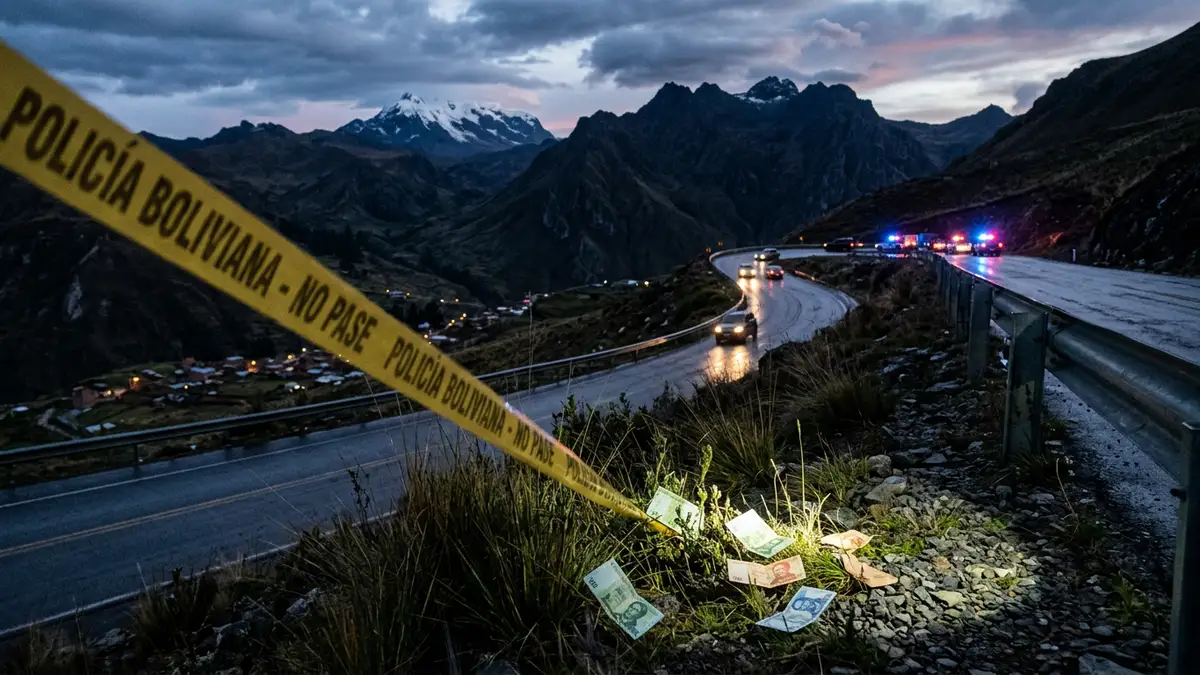
Image: Matt Weston / AI

Sarah Connor
A Bolivian Air Force Hercules C-130 military cargo plane crashed near La Paz, killing at least 15 people and destroying a dozen vehicles on a major transit route.
The heavy-lift Hercules C-130 executed a high-stakes logistics mission, transporting a massive shipment of new banknotes from Santa Cruz to the nation's interior.
This specific airframe serves as a foundational asset for the Bolivian Air Force, designed for high-capacity military and economic transport.
The impact unleashed extensive mechanical carnage upon motor vehicles circulating in the area at the moment of the crash. Emergency crews occupied the site through Friday evening, wrenching apart twisted metal to secure the volatile impact zone.
Bolivian Air Force General Sergio Lora confirmed that the tragedy remains an active recovery operation. As of late Friday, two of the six crew members aboard the aircraft remain unaccounted for amidst the debris.
Search teams continue to scan the charred remains of the fuselage and the surrounding landscape for the missing personnel. Meanwhile, the nature of the cargo has drawn intense scrutiny from financial authorities.
The aircraft carried currency destined for the national banking system, yet the bills lacked any immediate financial utility. Central Bank President David Espinoza clarified that the banknotes held no legal tender status because they had not yet entered formal circulation.
The bills have no legal value because they never entered circulation.
The bills lacked the mandatory serial numbers required to function as valid currency in the marketplace. 'The bills have no legal value because they never entered circulation,' Espinoza stated while addressing the status of the destroyed cargo.
Defense Minister Marcelo Salinas confirmed that the Bolivian Air Force held full responsibility for the transit of the currency from Santa Cruz.
In the wake of the fire, military investigators launched a comprehensive inquiry into the mechanical and environmental factors present during the flight.
Salinas noted that aviation authorities are currently dissecting the flight's trajectory to determine the exact cause of the descent. The investigation focuses on the specific conditions at the airfield during the aircraft's final, critical moments.
Historically, the Hercules C-130 has functioned as the backbone of South American military logistics due to its rugged short-strip landing capabilities.
This incident represents a significant loss of life involving both military specialists and civilians on a vital public artery.
Economic stakeholders within the national banking system face no direct financial deficit from the incinerated cargo.
Because the notes were not yet legal tender, the Central Bank maintains the total integrity of the national money supply despite the physical destruction.
Public pressure on the Ministry of Defense intensifies following aviation disasters that spill over into civilian transit zones.
The proximity of this crash to active traffic lanes highlights the persistent risks of operating heavy military transports near urban centers.
General Sergio Lora reiterated that locating the two missing crew members remains the absolute priority for recovery teams.
Personnel are currently using specialized equipment to sift through the crushed remains of vehicles and the aircraft's skeleton.
The landscape of the crash site remains strictly cordoned off as forensic investigators document the distribution of the wreckage.
This data is essential for reconstructing the final seconds of the flight to determine if engine failure or weather played a decisive role.
Future safety protocols for military flights over civilian routes may undergo rigorous revision following the conclusion of this formal inquiry.
Authorities must now balance the necessity of heavy logistics with the safety of the public using roads adjacent to military runways.
The recovery of the uncirculated currency remains a secondary but necessary task for the emergency crews still on the scene.
Securing the area prevents any potential public confusion regarding the status of the non-valid banknotes scattered across the site.
The Bolivian Air Force continues to coordinate with local emergency services to manage the complex aftermath of the disaster.
This collaboration remains vital for the formal identification of the deceased and the subsequent notification of their families.