U.S. Forces Execute Massive Strike on Iran’s Kharg Island Military Assets
President Trump confirms the total destruction of military targets on Tehran’s primary oil export hub as regional fatalities surpass 2,000.
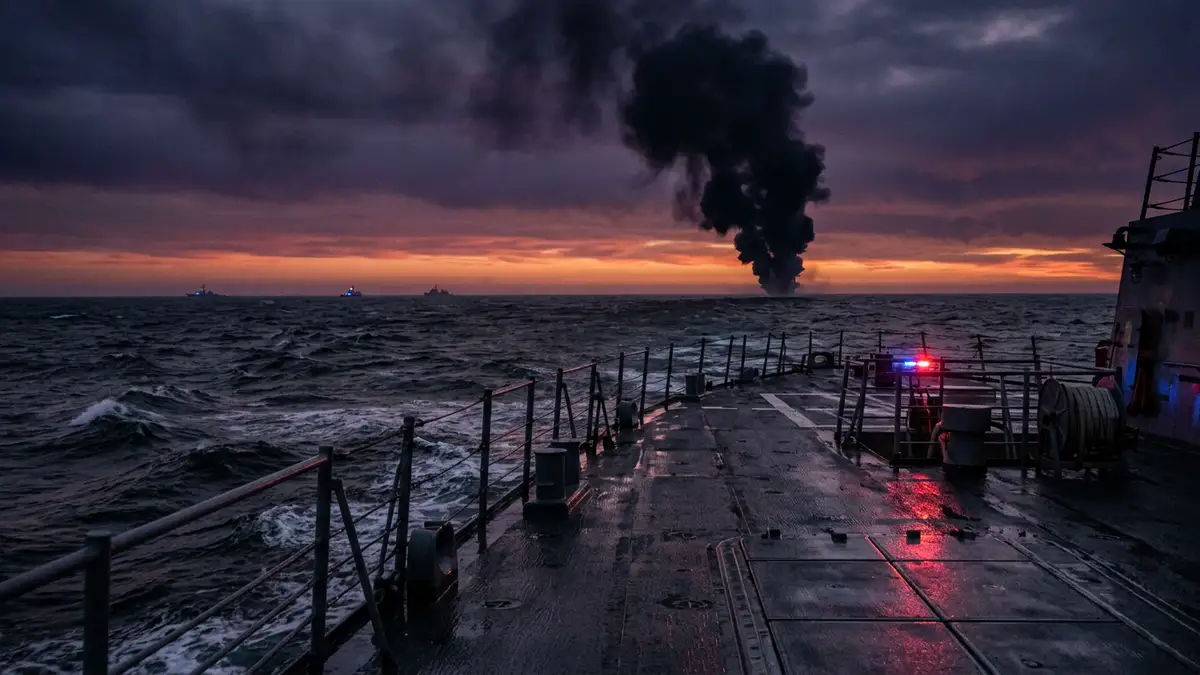
Image: Matt Weston / AI

Carla Rooney
U.S. Central Command forces have decimated military installations on Iran’s Kharg Island in a massive aerial assault that marks a shift toward direct engagement with Iranian sovereign territory.
Kharg Island serves as the primary economic artery for Tehran. It facilitates approximately 94% of the nation’s crude oil exports.
U.S. Central Command (CENTCOM) forces obliterated every military target on the island during the assault.
This kinetic action follows a period of escalating regional violence, including a blockade of the Strait of Hormuz by Tehran and an attack on the U.S. embassy in Baghdad.
Plumes of smoke rose from the embassy building in Iraq as the U.S. military increased its presence across the Middle East.
Historically, Kharg Island has functioned as the 'crown jewel' of Iran’s energy infrastructure.
Iran is now virtually defenseless against American assaults and has no ability to protect assets the U.S. chooses to attack.
The military moved toward direct engagement with Iranian sovereign territory. This strategic shift replaces previous containment strategies with active combat.
Trump stated that the U.S. refrained from targeting the island's actual oil infrastructure for reasons of decency.
He claimed that Iran is now virtually defenseless against American assaults and has no ability to protect assets the U.S. chooses to attack.
Tehran responded to the operation by maintaining its blockade of the Strait of Hormuz. This waterway remains a critical chokepoint for global energy.
The Islamic Revolutionary Guard Corps (IRGC) has taken complete control of the waterway. They are threatening the stability of international shipping lanes.
Iranian military officials warned that any assault on their oil and energy infrastructure will result in immediate attacks on energy assets owned by oil companies collaborating with the U.S. in the region.
Iran vowed to reduce these resources to ashes if the conflict escalates further.
Economic pressure is mounting as oil and gas prices soar in response to the hostilities.
Market analysts and stakeholders are monitoring the Strait of Hormuz, where any prolonged closure threatens to disrupt the global energy supply chain.
The humanitarian cost of the broader regional conflict has reached a critical threshold. Over 2,000 deaths have occurred in the Middle East over the past two weeks.
This figure includes 687 fatalities confirmed by Lebanese authorities. Between 1,270 and 1,332 people have been killed in Iran, including 104 individuals during a U.S. attack on an Iranian warship.
Defense Secretary Pete Hegseth stated that over 15,000 enemy targets have been struck since the commencement of the war.
Political figures have voiced sharp criticism of the administration's strategy. Hal for NY claimed that Trump made one of the worst possible decisions by attacking the island.
He argued the move turns the current regional friction into a total nightmare. JD Vance refused to reveal the specific advice he provided to Trump regarding the Iran strategy.
The U.S. has offered a $10 million bounty for information on Iran’s new Ayatollah.
The landscape of the conflict suggests a shift toward total military dominance. Trump asserted that Iran is totally defeated and wants a deal.
He maintained that the country will never be permitted to possess a nuclear weapon.
Regional allies are facing direct spillover from the hostilities. Bahrain’s Defense Forces reported being targeted by over 200 Iranian drones.
A drone strike was launched on a critical port in the United Arab Emirates. Five U.S. Air Force refueling planes were struck by an Iranian missile in Saudi Arabia in recent days.
These actions coincide with a fresh wave of Iranian missiles heading toward Israel.
Despite the strikes, the deputy governor of Bushehr claimed that activities on Kharg Island, including exports and imports, are proceeding normally.
TankerTrackers.com and Kpler data also indicated that operations on the island have continued despite the military engagement.
Former Iranian Foreign Minister Manouchehr Mottaki warned that Iran will capture U.S. forces if they attempt to seize oil infrastructure on the island.
Iran will abandon all restraint if the islands come under further attack.
Mohammad Bagher Qalibaf stated that Iran will abandon all restraint if the islands come under further attack.
Trump remains firm on the efficacy of the strike, stating that the United States Military has done well against Iran.
He urged the Iranian military to lay down their arms to save what remains of their country.