Middle East Airspace Closures Enter Fourth Day as Retaliatory Strikes Hit Regional Hubs
Retaliatory strikes on Dubai and Doha trigger mass flight cancellations and leave thousands of British holidaymakers stranded across the Persian Gulf.
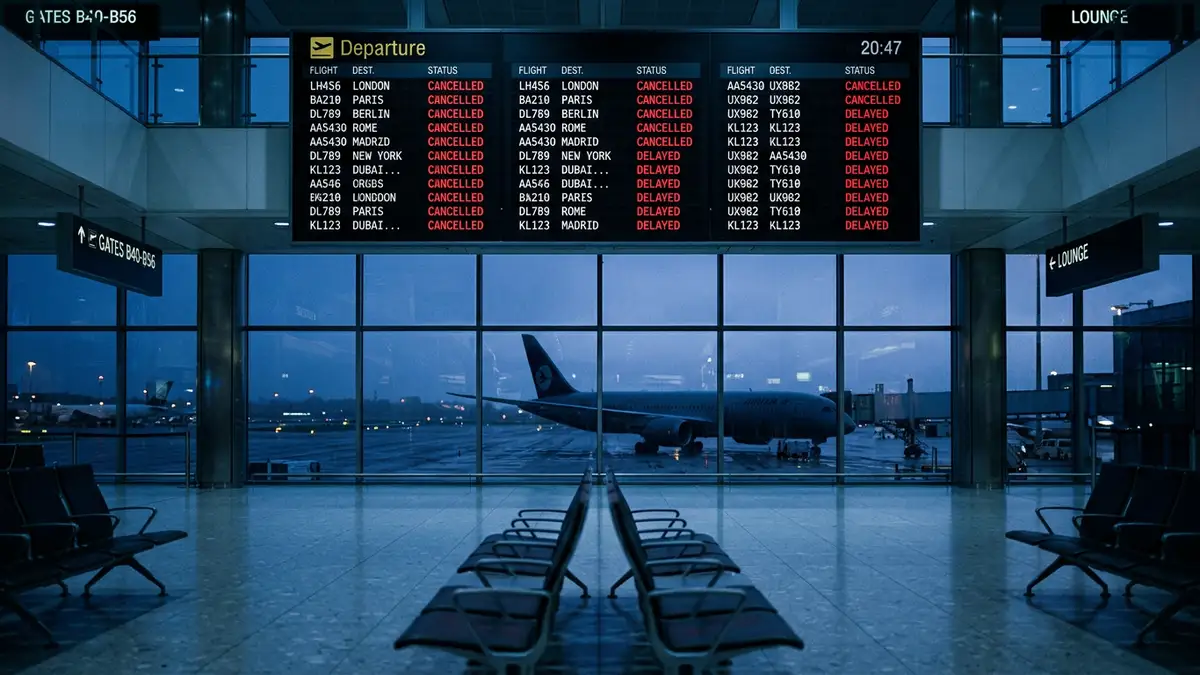
Image: Matt Weston / AI

Carla Rooney
Retaliatory attacks have struck Dubai, Doha, Bahrain, and Kuwait, targeting regions that host United States military installations alongside Israel as hostilities involving Iran enter a fourth day of chaos.
Emirates forced a single flight from Dubai to Manchester Airport this morning despite the wider lockdown. This isolated movement marks a desperate attempt by carriers to navigate a rapidly shifting map of flight restrictions.
The aviation landscape remains frozen as hostilities expand across the region. Qatar Airways responded by suspending all flight operations across its entire global network.
Official carrier statements confirm service will only resume once the Qatar Civil Aviation Authority declares the airspace safe. This shutdown severs the primary artery for international logistics and passenger transit.
Historical patterns show a consistent shuttering of civilian corridors to prioritize military movement during regional conflicts. This strategic shift follows the expansion of kinetic activity across the Persian Gulf.
British Airways issued revised formal guidance for all passengers scheduled to travel to Abu Dhabi, Amman, Bahrain, Doha, Dubai, and Tel Aviv. Customers holding bookings on or before March 15 may now modify travel dates without incurring additional charges.
Simultaneously, Qatar Airways offers complimentary date changes of up to 14 days for confirmed bookings between February 28 and March 10, 2026. Impacted travelers maintain the legal right to request a full refund for the unused value of their tickets.
The Foreign Office escalated its travel warnings, now advising against all but essential travel to Qatar. This policy shift reflects the volatility of the security environment on the ground.
British nationals caught in the crossfire began returning to the United Kingdom through limited, high-pressure channels. Several flights destined for Birmingham Airport were canceled today as the backlog of displaced passengers grew.
Current industry projections indicate that clearing the volume of stranded travelers will require several days of uninterrupted flight operations. Ground crews and logistics teams manage thousands of individuals unable to secure viable exit routes.
Prime Minister Sir Keir Starmer confirmed the Government is evaluating all available mechanisms to support British citizens abroad. He noted that the situation on the ground may remain challenging for a significant period.
Britain will not join any offensive action directed at Iran.
Starmer defined the strict parameters of British military involvement in the escalating regional conflict. He stated clearly that Britain will not join any offensive action directed at Iran.
This disruption threatens decades of strategic reliance on the Gulf as the world's primary transit hub. Dubai and Doha function as the connective tissue for flights linking Europe, Asia, and Oceania.
Economic pressure mounts as carriers absorb massive fuel costs associated with rerouting aircraft around closed sectors. The total suspension of Qatar Airways operations removes one of the world's largest fleets from the regional network.
Security protocols at Manchester and Birmingham airports bolstered their presence to manage the influx of diverted and delayed arrivals. Ground staff process passengers as they trickle in from the affected conflict zones.
The Prime Minister's office maintains a constant monitor on the status of UK citizens located within the danger areas. Starmer reiterated that every available resource is being deployed to facilitate a safe return for those trapped.
The targeting of hubs like Bahrain and Kuwait marks a dangerous escalation in the geography of the conflict. These locations host critical United States military installations, complicating the security calculus for civilian aviation.
Logistics experts warn that a prolonged closure of these hubs threatens the stability of global supply chains. The Persian Gulf remains one of the most densely trafficked corridors for high-value cargo and international passengers.
Airlines burn through cash reserves as they navigate the logistical nightmare of maintaining grounded fleets. This suspension by major flag carriers creates a market vacuum that smaller regional players cannot fill.
Ground staff at Manchester Airport report a surge in inquiries from families awaiting news of relatives stuck in the UAE. This backlog will persist well into next week, even if the regional airspace reopens immediately.