Hawaii Flooding Triggers Mass Evacuations as Damage Estimates Hit $1 Billion
Governor Josh Green warns of a massive recovery bill as the most severe storm in two decades submerges infrastructure and isolates communities.
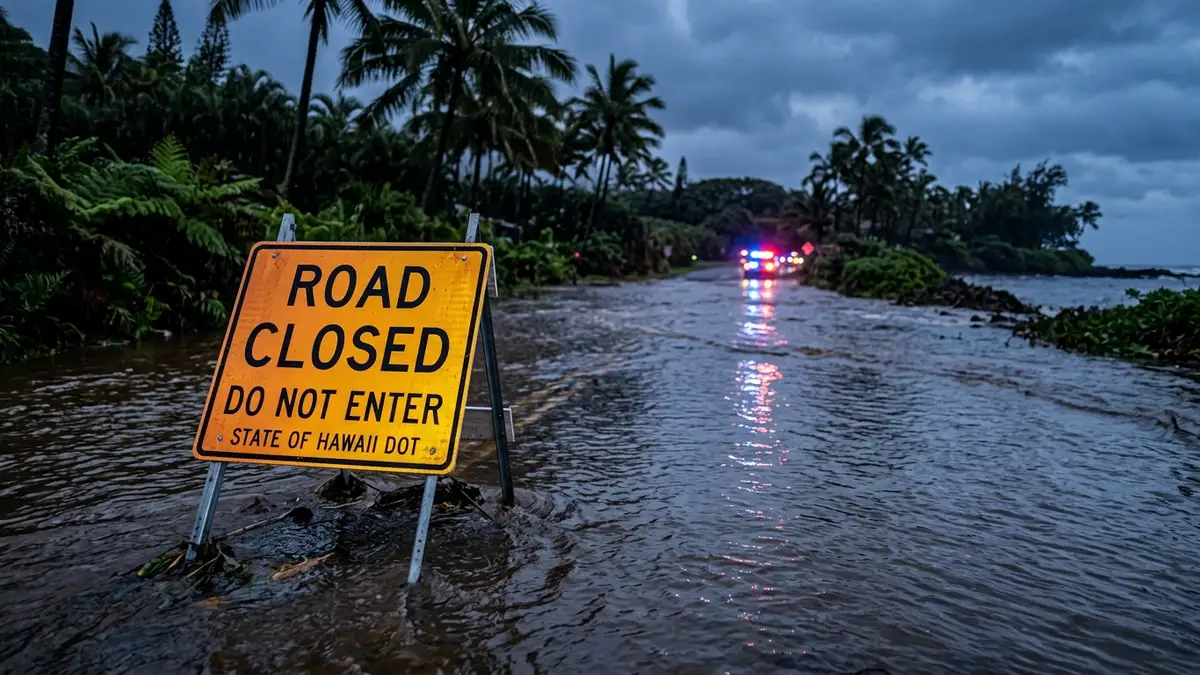
Image: Matt Weston / AI

Sarah Connor
Hawaii is facing a catastrophic flooding crisis with damage estimates reaching $1 billion as record-breaking rainfall forces thousands to evacuate the North Shore.
Governor Josh Green confirmed the total cost of the destruction could top $1 billion as the water continues to rise.
Honolulu Mayor Rick Blangiardi projected that the damage may exceed £745 million, marking a definitive regional collapse.
Emergency crews navigate submerged infrastructure to reach isolated populations cut off by the rising water.
Many citizens have already lost their vehicles to the floodwaters.
North Shore state representative Amy Perruso stated that many citizens have already lost their vehicles to the floodwaters.
This crisis follows a historical pattern of Pacific weather cycles that periodically overwhelm the islands' drainage systems.
Surpassing the benchmarks set by major storms in the early 2000s, this event marks a two-decade peak in moisture volume.
Meteorological data indicates the volume of water has exceeded the capacity of existing flood mitigation hardware.
Public works departments deploy heavy machinery to clear drainage channels and prevent further backflow into residential neighborhoods.
State officials scrutinize the integrity of local water barriers and reservoirs to prevent structural failures.
Dole officials stated that their dam continues to operate as designed with no current indications of damage.
Our water management systems remain structurally sound despite the record-breaking volume.
The Dole corporation maintains that its water management systems remain structurally sound despite the record-breaking volume.
Engineers conduct 24-hour surveillance of the dam's spillways to ensure continued stability.
Economic pressure mounts as the $1 billion estimate threatens to strain state recovery funds.
The agricultural sector and residential property markets face the highest concentration of financial loss from the standing water.
This £750 million equivalent in damages represents a massive portion of the annual infrastructure budget.
Legislative leaders review emergency allocation protocols to address the projected shortfall.
Governor Josh Green coordinates with federal agencies to secure disaster relief funding.
The $1 billion threshold serves as a trigger for expanded national assistance from the federal government.
Residents in the evacuation zones have moved to higher ground or designated emergency shelters.
Local law enforcement patrols the evacuated perimeters to secure abandoned properties and prevent looting.
The long-term societal shift involves a reassessment of coastal and valley building codes.
Current damage patterns show that older structures fail at significantly higher rates than modern builds.
Future climate projections suggest an increase in the frequency of these high-intensity moisture plumes.
State planners utilize the current $1 billion damage map to identify future high-risk zones for development.
North Shore representative Amy Perruso confirmed that emergency services struggle to access certain residents due to the severity of the road blockages.
Heavy machinery grinds through the primary transit arteries to restore logistics.
State recovery funds require significant replenishment to handle the scale of the agricultural losses.
Officials monitor the moisture event as the rain persists across the islands.