Geomagnetic Storm Triggers Northern Lights Display Across United Kingdom
Solar Activity and Coronal Mass Ejections Expand Aurora Visibility to Southern England
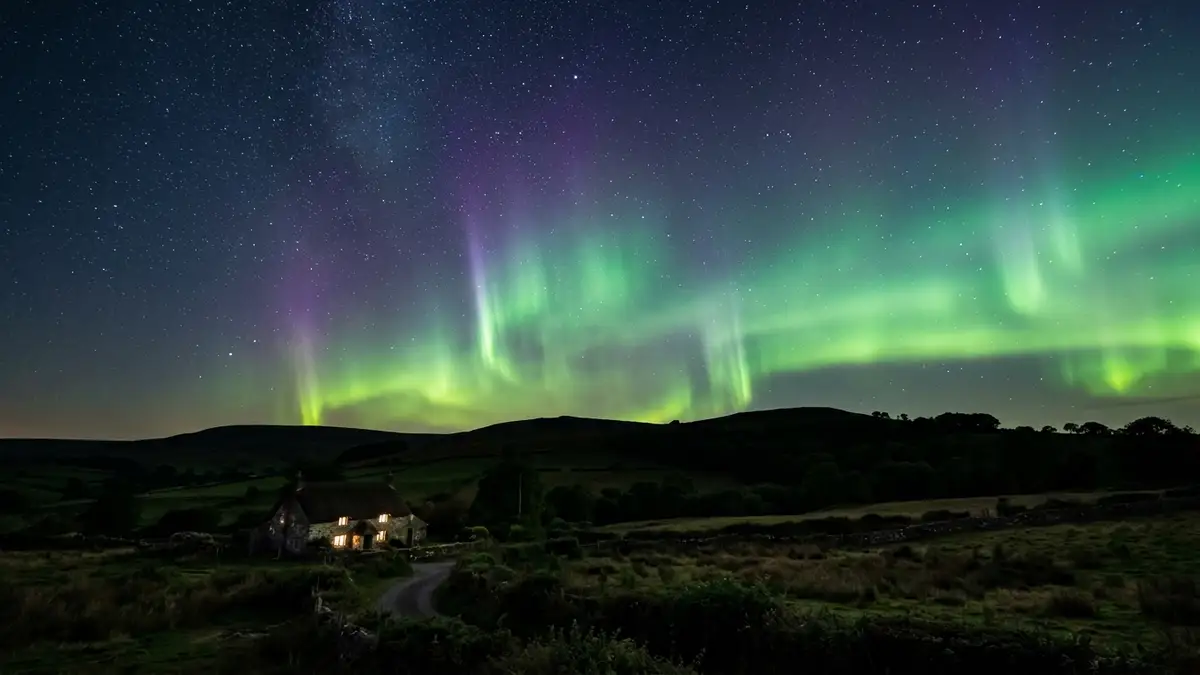
Image: Matt Weston / AI

Callum Smith
The Northern Lights will reappear over the United Kingdom tonight as a strong geomagnetic storm impacts the atmosphere, driven by increased solar activity and the arrival of Coronal Mass Ejections.
Current forecasts indicate sightings will extend as far as the south of England during the overnight period.
While observers in northern regions typically see the lights more frequently, the current storm strength expands the visibility zone significantly.
The Met Office confirmed that further Coronal Mass Ejections (CMEs) will arrive throughout March 21.
A coronal hole high-speed stream is also expected to connect to Earth during this window.
Solar cycles dictate the frequency of these events. Public interest in the aurora borealis has surged as the solar cycle approaches its predicted maximum.
This peak in activity ensures that charged particles are ejected with greater velocity and volume.
The sun's magnetic field flips during this phase, leading to an increase in sunspots and solar flares.
Infrastructure operators are tracking geomagnetic fluctuations to prevent potential disruptions to GPS and high-frequency radio signals.
Economic impacts of such storms involve monitoring satellite communications and power grid stability.
Technicians at power utilities monitor ground induced currents resulting from these geomagnetic disturbances.
Large-scale storms in the past have required the isolation of specific grid components to protect transformers.
Combined CME impacts will gradually wane through March 21 into the early hours of March 22.
Solar wind speeds will increase during March 22 and continue through March 23.
The Met Office expects the intensity of the solar wind to ease by March 24.
This timeline provides a multi-day window for atmospheric observation across various latitudes.
The interaction between the solar wind and the Earth's magnetic field creates shimmering curtains of green and red light.
These colours depend on whether the particles strike oxygen or nitrogen at different altitudes.
The Met Office predicted more sightings of the Northern Lights across various latitudes tonight as the storm reaches its peak.
Clear skies remain the primary requirement for those attempting to view the phenomenon from the ground.
Aviation authorities are tracking space weather to manage radiation exposure for crews on polar flight routes.
During strong storms, some flights are rerouted to lower latitudes to maintain communication links.
The arrival of the coronal hole high-speed stream adds a layer of complexity to the current forecast.
This stream of plasma originates from cooler, less dense areas of the sun's corona where the magnetic field is open to space.
As the solar wind speed increases over the next 48 hours, the pressure on the Earth's magnetosphere will remain elevated.
This sustained pressure keeps the auroral oval expanded further toward the equator than during quiet solar periods.
The Met Office is providing updates as the CMEs interact with the atmosphere.
These updates serve the scientific community and the public tracking the movement of the lights.
The current event marks one of the most significant periods of geomagnetic activity recorded in the current calendar year.
It records the sun's direct influence on the terrestrial environment through measurable plasma impact.
Observers are moving to areas with low light pollution to capture the full scale of the display.
The intensity of the aurora will fluctuate as the different solar streams merge and pass the planet.