Saharan Dust Cloud Triggers Blood Rain and Record Temperatures Across Britain
Northolt hits 19.2C as atmospheric debris from North Africa settles over the United Kingdom.
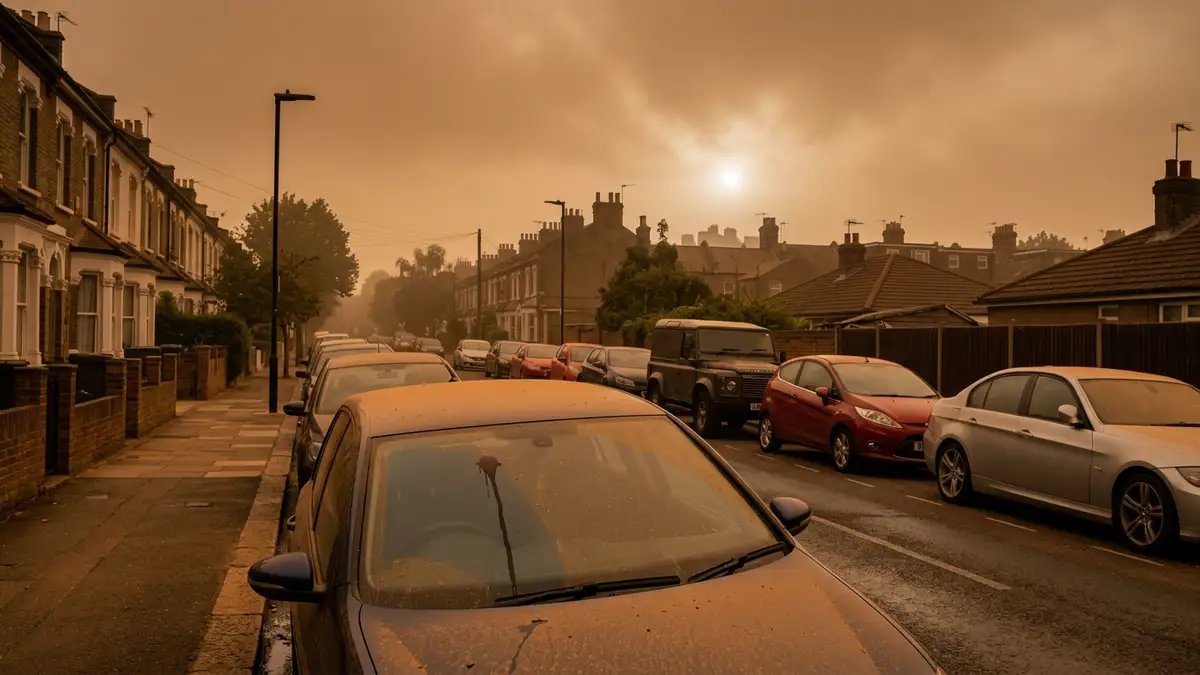
Image: Matt Weston / AI

Carla Rooney
A massive Saharan dust cloud has crossed into British airspace, generating orange-tinted sunsets and the rare meteorological phenomenon known as blood rain.
The rainfall carries a spectrum of color ranging from a faint rusty hue to a deep, visceral red. This coloration depends entirely on the density of the suspended debris within the water droplets.
London currently holds the position of the warmest sector in the country. Temperatures reached the high teens across the capital this afternoon.
A Met Office spokesperson confirmed the London region will remain the national hotspot as temperatures climb widely. In Liverpool, the March 5 forecast indicates a high of 17C and a low of 6C.
These figures sit far above seasonal norms while the tropical continental air mass dominates the national weather profile. The shift triggered active air pollution health alerts across multiple UK regions as the dust plume settled.
Tomorrow, skies will be less visible as it is more cloudy so the best chance to see a great sunset is this evening.
The Met Office confirmed the influx of particulate matter will cause hazier skies and leave a visible light coating on outdoor surfaces. Motorists received instructions to avoid washing vehicles until the cloud passes to prevent surface scratching.
The abrasive silica-rich Saharan sand causes permanent damage to paintwork if wiped or scrubbed manually. Professor Claire Ryder from the University of Reading stated the best window for observing the sunset is this evening before cloud cover increases.
"Tomorrow, skies will be less visible as it is more cloudy so the best chance to see a great sunset is this evening," Ryder noted. Weather presenter Jo Wheeler confirmed the atmospheric display would remain noticeable across the UK throughout the week.
High-altitude winds propel millions of tonnes of dust from the Sahara Desert to drive this phenomenon. While southern regions experience record warmth, the northern landscape presents a sharp contrast.
Patches of snowfall are falling over the Pennines and Southern Uplands where the warm air mass meets colder Atlantic fronts. Across the channel, Europe sustains a higher impact than the UK due to its closer geographical proximity to the Saharan source.
Spain and France report significantly higher concentrations of particulate matter than the British Isles. Historically, these events occur when strong winds over the Maghreb region lift dust into the troposphere.
Once caught in the jet stream, the particles travel thousands of miles before local rainfall washes them out. Public health officials are monitoring the situation as the dust increases the concentration of PM10 particles.
Those with respiratory conditions received advice to limit strenuous outdoor activity while the haze persists. The economic impact of the dust hits the agricultural and solar energy sectors with specific intensity.
Dust accumulation on solar panels reduces energy output by up to 30 per cent until crews professionally clean the surfaces. This event follows a documented pattern of increasing frequency for Saharan intrusions into Northern Europe.
Scientists at the University of Reading track the movement of the plume using satellite imagery and ground-based sensors. The Met Office continues to monitor the boundary between the warm southern air and the colder northern systems.
This temperature gradient generates the volatile mix of record heat and upland snow currently observed. Visibility at major airports, including Heathrow and Gatwick, may drop during peak hours due to the haze.
Pilots received briefings on the potential for reduced slant-range visibility during landings and take-offs. The dust cloud will linger for several days before a shift in wind direction clears the British Isles.
The combination of unseasonable heat and red-tinted rain remains the dominant feature of the national climate. This Saharan intrusion represents a physical shift in the atmospheric composition over the United Kingdom.