Australia Grants Humanitarian Visas to Seven Members of Iranian Football Delegation
Defecting players face accusations of wartime treason from Tehran after refusing to sing national anthem
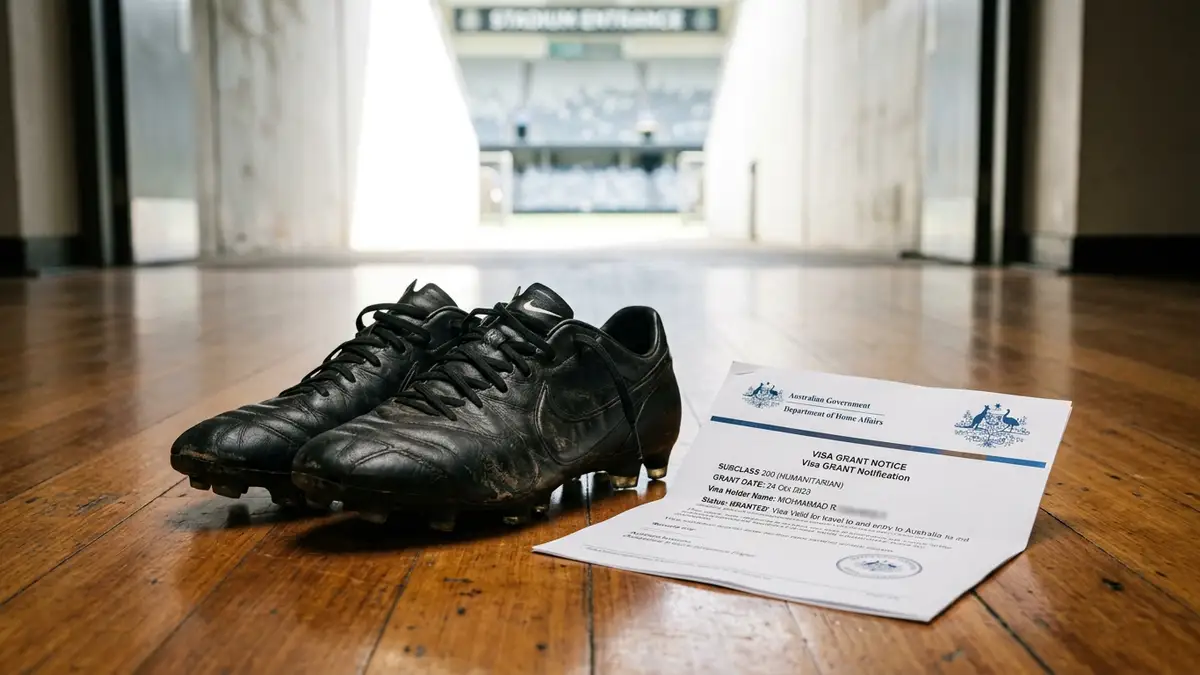
Image: Matt Weston / AI

Sarah Connor
Australian Home Affairs Minister Tony Burke confirmed the government has granted humanitarian visas to seven members of the Iranian women's football delegation following their refusal to perform the national anthem.
This coordinated defection follows a public demonstration where the squad stood in total silence during the Iranian national anthem. This act mirrors a widening pattern of athletic dissent that has fractured the Iranian sporting landscape since the civil unrest of 2022.
The reaction from Tehran was instantaneous. Iranian state television branded the women 'wartime traitors,' with one commentator describing their silence as the 'pinnacle of dishonour' while demanding state punishment.
The pinnacle of dishonour.
Mehdi Taj, President of Iran's Football Federation, alleged that Australian Prime Minister Anthony Albanese ordered a police intervention at the team hotel. Taj claimed that authorities physically blocked the team's scheduled departure and pressured the athletes into seeking asylum.
Ismail Baghaei, spokesman for Iran's Ministry of Foreign Affairs, accused Australia of taking the players hostage. Baghaei stated that the athletes are being exploited, citing a historical grievance involving the death of 170 schoolgirls in Minab.
The logistics of the defection shifted when one player reversed her decision and returned to Tehran. Before her departure, she disclosed the secret location of her teammates to the Iranian Embassy.
Migration agent Naghmeh Danai alleged that this returning player was subjected to intense coercion. Danai stated the Iranian regime utilized specific psychological techniques to force the athlete back to the capital.
Before breaking away from the delegation, the defecting players detailed an environment of constant surveillance. Leigh Swansborough stated that Iranian officials monitored every physical movement of the squad.
Tina Kordrostami detailed the intensity of the security environment during the final moments of the defection. She compared the sensation of being watched to the pursuit of a serial killer.
Iranian officials monitored every physical movement of the squad.
The consequences for those left behind are mounting. Iranian refugee advocate Ara Rasuli reported that the families of the seven athletes now face direct threats of detention.
Rasuli noted that the regime frequently seizes the assets of relatives to compel the return of citizens who defect during international assignments. This economic and physical pressure serves as a primary tool of the state's reach beyond its borders.
The Iranian Embassy in Malaysia stated that the remaining squad members will return to Tehran as soon as regional airspace reopens. Officials issued a warning, stating they have 'their finger on the trigger' regarding both internal and external dissent.
International figures have also entered the fray, with Donald Trump addressing the crisis on Truth Social. He stated that some players felt forced to return due to concerns for their families and urged the Australian government to provide swift asylum.
Mehdi Taj further alleged that Trump threatened to grant the players asylum in the United States if Australia failed to act. Taj claimed the U.S. President issued two specific communications regarding the team's status and future.
Exiled crown prince Reza Pahlavi confirmed that five of the players are currently situated in a secure, undisclosed location. Sydney-based Iranians have identified Golnoosh Khosravi as a central figure among those who chose to break ties with the regime.
In the media sphere, Piers Morgan criticized American footballer Megan Rapinoe for her silence on the plight of the Iranian team. Morgan labeled the lack of public support from prominent Western feminists as 'damning and hypocritical.'
Historically, the Iranian government has utilized sport as a primary platform for nationalistic display and rigid political control. This incident follows a long timeline of the regime targeting athletes who use the international stage to signal political dissent.
Ismail Baghaei issued a public message to the defectors, stating, 'Iran awaits you with open arms. Do not worry. Return home.'
This invitation coincides with the application of intensified pressure on the families of the seven women remaining in Australia. The Australian government has withheld further details regarding the athletes' locations to ensure their physical safety.