Bayeux Tapestry Arrives in London, British Museum Prepares for Exhibition
Ancient artwork crosses Channel, sparking cultural exchange and record ticket sales.

Sarah Connor
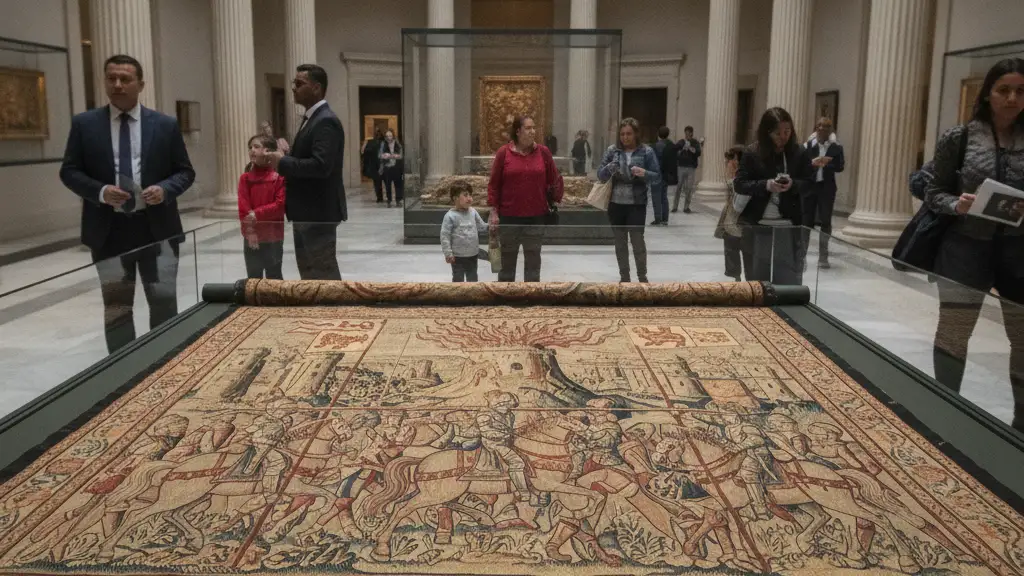
The Bayeux Tapestry, a 1,000-year-old masterpiece, has arrived at the British Museum in London, marking a significant moment in Anglo-French cultural relations.
The loan agreement for the Bayeux Tapestry was announced in July 2025 during French President Emmanuel Macron's state visit to the UK.
This historic exhibition runs from September 2026 to July 2027, allowing a lengthy period for public viewing at the British Museum.
Public interest surged immediately upon the announcement; the British Museum sold 100,000 tickets on the first day of sales alone.
This figure demonstrates intense public engagement with the tapestry and its intricate historical narrative; an estimated 7.5 million people will visit the British Museum to see the artwork.
The tapestry itself endures for nearly a millennium, surviving numerous historical dangers and conflicts.
It meticulously depicts 627 people and 737 animals across 58 distinct scenes, detailing pivotal historical events.
Historians confirm women in England, possibly nuns, likely sewed the tapestry before its original journey across the Channel.
This origin story establishes the artwork's complex Anglo-French identity, weaving together shared heritage.
The Bayeux Tapestry can arouse obsessiveness of many kinds in modern historians.
The tapestry binds the often fractious, yet deeply intertwined, histories of France and Britain, symbolizing their complex relationship.
It chronicles centuries of shared narrative, from conquest to cultural exchange, visually linking the two nations.
The tapestry's arrival in London follows historical precedents of significant cultural artifacts moving between nations, traveling from France through the Channel Tunnel.
These movements often mark periods of diplomatic rapprochement or increased focus on shared heritage, as seen with the reciprocal loan of treasures from the Sutton Hoo hoard to museums in Normandy.
Economically, the exhibition generates substantial revenue for the British Museum and the wider London tourism sector.
This influx of visitors boosts local businesses, from hospitality to retail, throughout the exhibition's duration.
The long-term implications extend beyond tourism, strengthening cultural ties and encouraging further collaborative projects between British and French institutions.
The tapestry's presence in London allows a new generation to engage directly with a foundational document of European history.
Professor George Garnett stated the Bayeux Tapestry can arouse obsessiveness of many kinds in modern historians.
President Emmanuel Macron remarked that the tapestry's conclusion eludes us, noting its final scene does not bring the story to a close.
The tapestry's conclusion eludes us; its final scene does not bring the story to a close.
The Bayeux Museum in France is closed for renovation until 2027, coinciding with the tapestry's display in London, creating a unique window for its international exhibition.