Metropolitan Police Deploy 1,000 Officers as Pro-Tehran Protesters Defy March Ban
Authorities utilize the River Thames to separate opposing factions following Home Secretary's prohibition of Al-Quds Day procession.
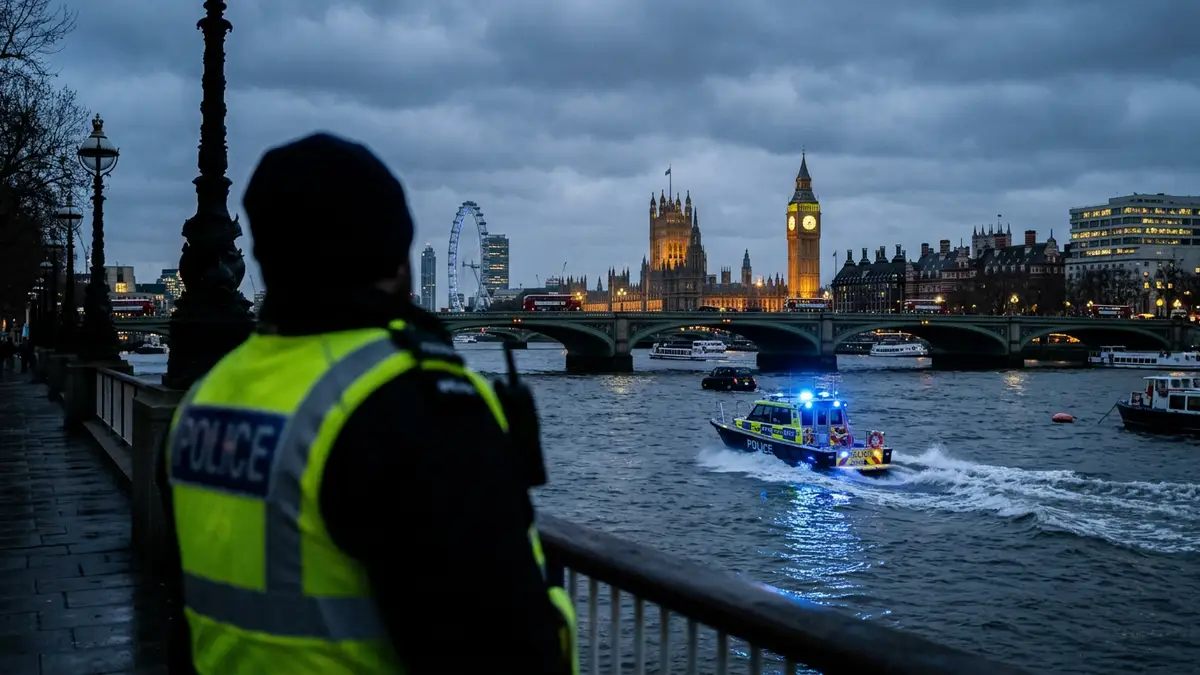
Image: Matt Weston / AI

Callum Smith
The Metropolitan Police mobilized more than 1,000 officers across central London on Sunday to enforce a strict ban on the Al-Quds Day march.
The Islamic Human Rights Commission (IHRC) organized the gathering, an event that has historically drawn scrutiny for its ties to the Iranian administration.
Police commanders established the River Thames as a physical barrier to sever contact between the IHRC-led group and a planned counter-demonstration.
Officers have cordoned off specific access points to the bridges to lock the assembly into a static position.
This tactical deployment utilizes the water as a neutral zone between opposing factions.
The police have brazenly abandoned their sworn principle of policing without fear or favour.
The Metropolitan Police secured a month-long ban on marches linked to these specific demonstrations through the streets of Westminster.
While movement is illegal under this order, participants retain the legal right to assemble for a static protest.
The Home Office order confines all demonstrations to a two-hour window between 1 p.m. and 3 p.m.
The designated protest zone spans the specific corridor between Vauxhall Bridge and Lambeth Bridge.
The IHRC stated the gathering would proceed in defiance of the Government ban on the march.
The organization claimed the police have capitulated to the pressure of the Zionist lobby.
Met Assistant Commissioner Ade Adelekan confirmed that police patrols are active around places of worship, community venues, and embassies.
These units operate in addition to the 1,000 officers stationed at the primary protest site on the Embankment.
The Al-Quds Day event originated in 1979 following the Iranian Revolution.
It serves as an annual international day of protest against Israeli control of Jerusalem.
Financial records show the IHRC received £458,500 in taxpayer-funded donations since 2020.
This funding history exists alongside the group's long-standing role as the primary UK coordinator for Al-Quds Day.
Political pressure regarding Iranian influence in the United Kingdom has intensified in recent months.
Ed Miliband described Iran as an evil regime during recent discussions on foreign policy.
Sir Ed Davey stated that the United Kingdom should not be at the beck and call of Donald Trump regarding international alignments.
These statements coincide with increased scrutiny of domestic groups linked to Tehran.
The IHRC alleged that the police have brazenly abandoned their sworn principle of policing without fear or favour.
The group maintains that the march ban represents a political maneuver rather than a security necessity.
Previous unrest involved mosques being firebombed. Armed protesters shot at civilians to incite chaos and shift blame onto authorities.
Faisal Bodi claimed that previous unrest involved mosques being firebombed.
He further alleged that armed protesters shot at civilians to incite chaos and shift blame onto authorities.
The current police strategy utilizes the geography of the Embankment to prevent direct contact between rival factions.
This tactical use of the river aims to mitigate the risk of physical altercations in the heart of the capital.
The month-long ban on marches prevents any organized movement through the streets of Westminster.
This legal mechanism forces all participants to remain within the Vauxhall-Lambeth corridor for the duration of the event.
Police commanders have not specified the duration of the heightened patrol presence at community venues.
The operation continues as the 3 p.m. deadline for the static assembly approaches.
Officers in high-visibility vests currently line the perimeter of the protest zone.
The Metropolitan Police continue to monitor the crowd density as the legal assembly window nears its conclusion.