Trump Replaces Kristi Noem with Markwayne Mullin as DHS Chief
The President shifts Noem to a new security initiative following testimony regarding a $220 million taxpayer-funded ad campaign.
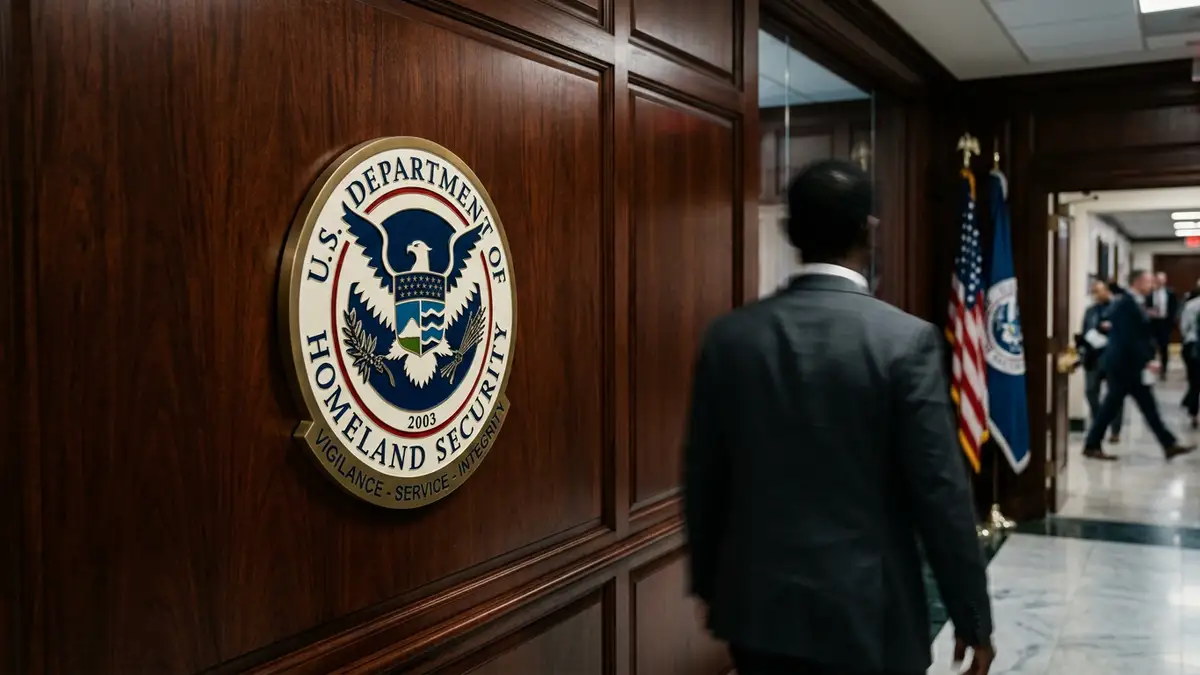
Image: Matt Weston / AI

Sarah Connor
President Donald Trump has removed Kristi Noem as Secretary of the Department of Homeland Security, appointing Senator Markwayne Mullin to lead the agency amidst a significant leadership restructuring.
Kristi Noem now transitions into the role of Special Envoy for The Shield of the Americas. This position manages regional security partnerships across the Western Hemisphere.
This sudden pivot follows a period of sustained pressure regarding the internal operations and budgetary management of the Department of Homeland Security.
The leadership change occurred in tandem with Noem’s appearance before the Senate and House Judiciary committees on Tuesday.
During these proceedings, lawmakers interrogated the Secretary on a series of fiscal decisions and personal conduct matters.
Under oath, Noem confirmed she secured presidential approval for a $220 million advertising campaign funded entirely by taxpayers.
The President personally signed off on the multi-million dollar expenditure.
She testified directly to Senator John Kennedy that the President personally signed off on the multi-million dollar expenditure.
The contract for this media blitz followed what Noem described as a rigorous and competitive bidding process.
Throughout the hearing, she maintained that every stage of the transaction complied strictly with federal procurement laws.
Defending the expenditure, a Department of Homeland Security spokeswoman labeled the domestic initiative the most successful advertising campaign in United States history.
The department currently asserts that the strategic messaging effort saved the American taxpayer more than $39 billion.
The most successful advertising campaign in United States history.
Despite these claimed dividends, the $220 million price tag remains the primary target for members of the House Judiciary Committee.
Legislators continue to dissect the mechanics of the contract and the data used to calculate its ultimate effectiveness.
This transition also triggers the departure of Corey Lewandowski, a senior adviser who anchored Noem’s inner circle.
Lewandowski exits the Department of Homeland Security as Markwayne Mullin assumes control of the agency.
During the committee sessions, House lawmakers alleged that Noem maintained a sexual relationship with Lewandowski during his tenure at the department.
These specific allegations shadowed the Secretary’s leadership for several months, creating a persistent distraction within the executive branch.
Initial accounts of a romantic entanglement between the two officials surfaced last year, prompting immediate scrutiny from oversight bodies.
Both Noem and Lewandowski issued firm, public denials regarding the existence of any such relationship.
One source indicated that Lewandowski personally lobbied the President to secure Noem’s initial appointment to the top DHS post.
This specific connection serves as a focal point for critics examining the internal culture and hiring practices of the department.
Internal DHS sources confirmed the President prepared the dismissal orders days before the formal announcement reached the public.
The timing indicates the administration moved to execute the restructuring immediately following the conclusion of the public hearings.
Markwayne Mullin now takes the helm as the administration recalibrates its senior leadership team for the upcoming term.
His arrival brings a distinct legislative background to an office previously defined by Noem’s executive style.
The establishment of The Shield of the Americas represents a strategic pivot toward international cooperation over isolated domestic enforcement.
This initiative seeks to fortify the hemisphere by tightening security ties with key regional allies across the Americas.
Historically, the Department of Homeland Security has faced intense oversight regarding large-scale public relations and outreach spending.
The $220 million campaign stands as one of the largest single-issue expenditures in the two-decade history of the agency.
Security industry stakeholders monitor the transition for potential shifts in procurement protocols and border enforcement policy.
The relocation of Noem to a diplomatic role suggests a deliberate decoupling of domestic enforcement from broader regional strategy.
Economic analysts now weigh the DHS claim of $39 billion in savings against the immediate cash outlay of the ad campaign.
The verification of these figures will dominate the next cycle of congressional oversight hearings.
This restructuring arrives as the administration attempts to solidify a permanent security legacy before the next electoral cycle.
Mullin’s immediate mandate involves managing the fallout from the committee investigations while stabilizing agency morale.
Noem’s new mandate as Special Envoy requires her to navigate a landscape of complex and often volatile geopolitical relationships.
Her performance in this regional capacity dictates the long-term viability and influence of the Shield of the Americas project.