Secret Service Agents Fatally Shoot Armed Intruder at Mar-a-Lago Perimeter
A man carrying a shotgun and fuel canister was neutralized after breaching the secure boundary of the former president's Florida estate.
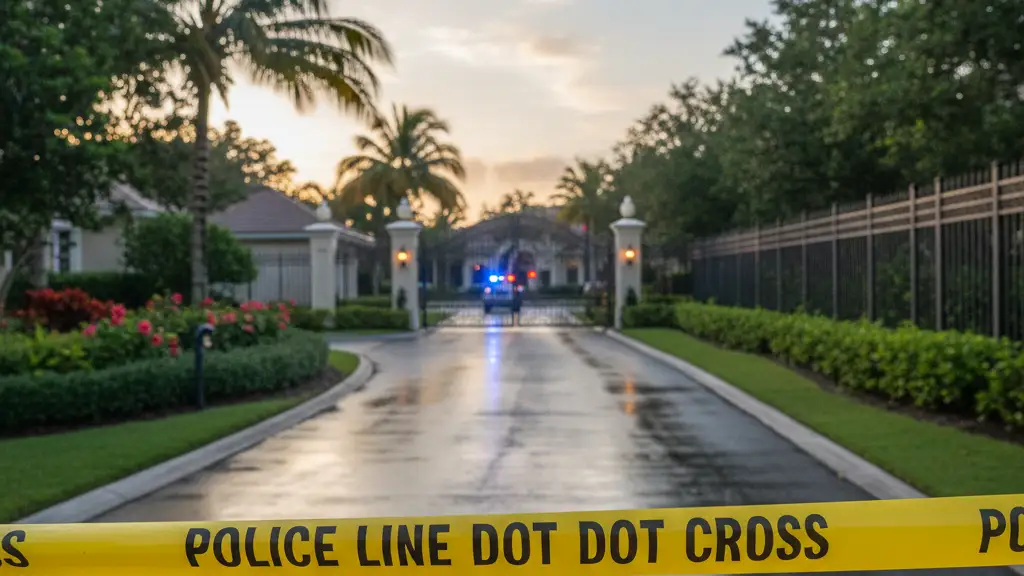
Image: Matt Weston / AI

Sarah Connor
United States Secret Service agents and local law enforcement fatally shot an armed man early Sunday morning as he attempted to breach the secure perimeter of Donald Trump’s Mar-a-Lago resort.
The encounter escalated with violent speed as security personnel moved to intercept the individual deep within the property's perimeter.
Agents engaged the armed man directly, unleashing a fatal volley of gunfire that neutralized the threat before he could advance toward the primary structures.
This decisive use of force ensured the breach remained contained at the outer edge of the historic estate.
Investigators believe the man, a 20-year-old who traveled south from North Carolina, specifically targeted the Florida club for this incursion.
Evidence suggests he acquired the shotgun during his transit, pointing to a calculated effort to arm himself before reaching the destination.
The individual was visibly brandishing both the firearm and a fuel canister at the moment of the encounter.
Secret Service spokesman Anthony Guglielmi stated the individual was visibly brandishing both the firearm and a fuel canister at the moment of the encounter.
The presence of an accelerant suggests a chilling intent for arson or explosive damage, significantly raising the stakes of the ongoing federal investigation.
While authorities have not yet released the deceased man's identity, they are meticulously tracing his digital footprint and movements prior to his arrival in Florida.
This forensic reconstruction aims to unearth any potential accomplices or markers of radicalization that fueled the trek south.
Donald Trump was in Washington D.C. when the incident occurred and was not present at the Florida club during the breach.
Despite his absence, the gravity of the event has sent shockwaves through the capital's high-level security apparatus.
This shooting follows a period of unprecedented danger for the former president, who has faced multiple assassination attempts during his tenure and subsequent campaigns.
The recurring nature of these threats has forced a total, aggressive re-evaluation of perimeter protocols at all private residences.
A deputy from the Palm Beach County Sheriff's Office was the specific officer who neutralized the man after he refused to comply with urgent commands.
The suspect's refusal to drop the weapon left the tactical team with no alternative but to employ lethal force to protect the site.
The North Carolina man’s specific motives remain under intense investigation as federal and local agencies process forensic evidence at the north gate.
Every item recovered from the scene is being treated as a critical piece of a larger, more dangerous puzzle regarding domestic security.
Beyond the immediate violence, this breach represents a significant escalation in the ongoing security challenges surrounding the Mar-a-Lago estate.
The property serves as both a primary residence and a high-stakes political hub, making it a persistent target for disruption and violence.
The strategic combination of a fuel canister and a firearm adds a layer of complexity that suggests a multi-stage attack plan.
Investigators are exploring whether the intruder intended to use both ballistic and incendiary elements to maximize the damage.
Local law enforcement has cordoned off the area surrounding the north gate to allow forensic teams to document the trajectory of the gunfire.
Technicians are also mapping the intruder's exact path to identify any blind spots in the existing surveillance network that he may have exploited.
The Secret Service has faced intense scrutiny over the past year regarding its ability to maintain sterile zones around high-profile protectees.
This latest incident will likely intensify the debate over the adequacy of current manpower and technology at sprawling private residences.
The seamless coordination between federal agents and local deputies was instrumental in stopping the intruder's advance.
Sheriff Bradshaw noted that the seamless coordination between federal agents and local deputies was instrumental in stopping the intruder's advance.
This unified front proved to be the final, impenetrable barrier between the suspect and the residential quarters.
The acquisition of the shotgun during the suspect's journey indicates a level of premeditation that investigators are currently mapping through physical evidence.
This timeline suggests the suspect did not act on a whim but followed a deliberate, logistical plan to strike the estate.
Security protocols at the West Palm Beach property have been under constant revision since previous unauthorized entries highlighted vulnerabilities in the fencing.
Each breach serves as a grim reminder of the persistent gaps in physical security measures that must be closed.
The incident underscores the increasingly volatile environment surrounding major political figures, necessitating a permanent and robust tactical presence.
The shift from passive monitoring to active combat engagement marks a new, more aggressive chapter in domestic protection duties.
Federal agents are expected to remain on-site for several days to conduct a comprehensive review of the breach and the use of force.
This internal audit will determine if further enhancements are required to fortify the estate against future, potentially more sophisticated incursions.