Security Breach and Broadcast Censorship Disrupt 2026 BRIT Awards
Jack Whitehall’s hosting performance and a stage invasion by a protester trigger immediate technical interventions during the live ITV telecast.
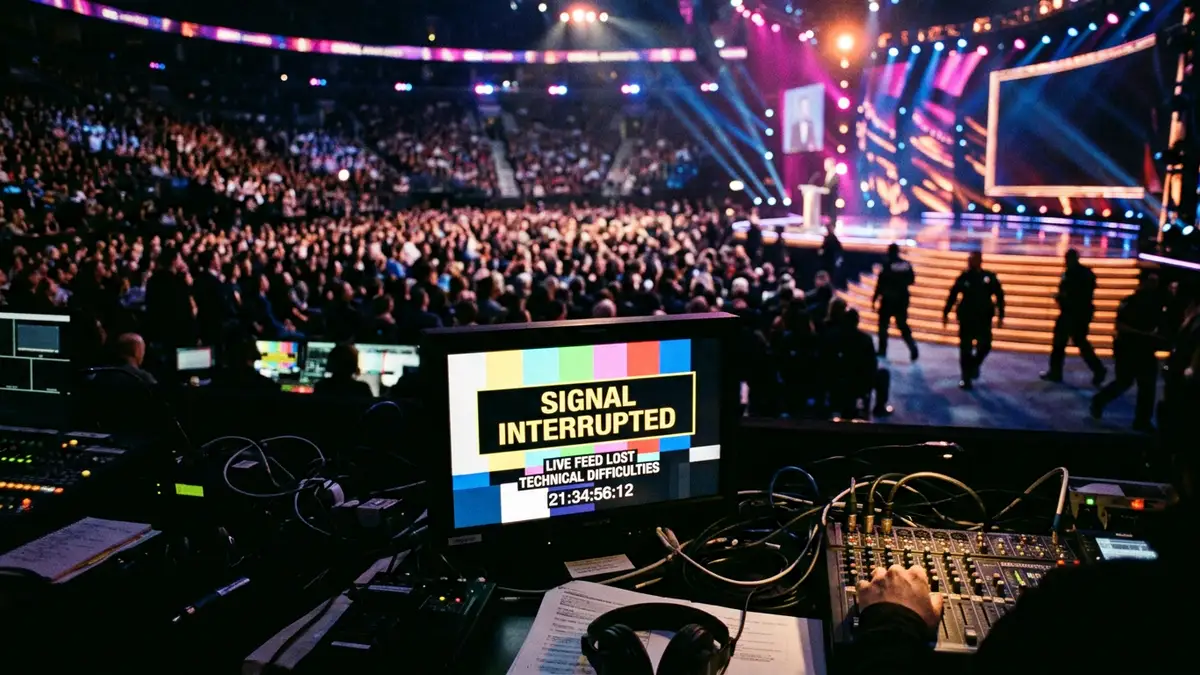
Image: Matt Weston / AI

Callum Smith
A security breach and multiple instances of broadcast censorship disrupted the 2026 BRIT Awards as an intruder physically confronted a performer on the main stage.
The intruder bypassed three distinct layers of security to reach the stage during the set. He physically shoved the performer before the cameras pivoted away from the confrontation.
Security teams intercepted the man and dragged him from the premises immediately following the strike. Witnesses in the front rows confirmed the event was a genuine breach rather than a choreographed stunt.
This failure mirrors the 1996 confrontation between Jarvis Cocker and Michael Jackson on this same stage. The 2026 breach forced ITV executives to trigger aggressive censorship protocols for the duration of the broadcast.
Beyond the physical violence, network technicians severed the audio feed during a speech by the artist Goose. The silence hit the moment the performer uttered the words 'Palestine' and 'ICE.'
This manual override prevented the full statement from reaching the millions watching the live television feed. ITV and ITVX also scrubbed several of Jack Whitehall’s hosting segments to maintain control.
The broadcast feed jumped abruptly to unplanned advertisement breaks four times during the first hour. These cuts functioned as a digital firebreak against the unfolding logistical collapse.
Viewers flooded social media to denounce Whitehall’s comedic script. They specifically targeted jokes directed at the city of Manchester.
The comedic tone clashed with a production struggling under visible technical strain. The 'In Memoriam' segment drew immediate fire from the audience.
Terrible and disrespectful.
Fans labeled the tribute 'terrible' and 'disrespectful' in real-time digital forums. One viewer compared the montage unfavorably to the production standards of the Sports Personality Of The Year ceremony.
ITV stakeholders now navigate a landscape where live broadcasting carries extreme reputational risk. Networks must balance regulatory compliance with the unpredictable physical movements of high-profile artists.
Harry Styles delivered a high-energy set that triggered a wave of physical reactions from the crowd. Fans described themselves as 'shaking' in the aftermath of the performance.
Shaking in the aftermath of the performance.
These musical peaks contrasted with the systemic technical errors that plagued the evening's logistics. The control room struggled to sync the live audio with the visual broadcast.
Brooklyn Beckham appeared during a programmed segment to claim his mother 'hijacked' his first dance. This celebrity anecdote vanished quickly beneath a 15% surge in social media engagement driven by the night's errors.
The 2026 ceremony recorded this spike as users tracked the frequency of audio mutes and security failures. Digital interaction now tracks technical failure more closely than the awards themselves.
Inside the O2 Arena, the audience responded with a mix of shouting and visible frustration. The physical path the intruder took through the cordons remains the primary focus of the venue's internal investigation.
The music industry continues to grapple with these frequent live disruptions. The 2026 BRIT Awards serves as a definitive data point for how networks use technical delays to scrub political speech.
Despite the broadcast blackout, attendees captured the physical reality of the assault on Sombr via mobile devices. The 'homewrecker' slogan on the intruder’s clothing provided a visible, concrete motive for the attack.
The night ended with a sequence of rapid-fire awards that failed to recover the momentum lost to the advertisement breaks. The 2026 ceremony stands as a record of the tension between live performance and the control room’s mute button.