One Dead and 20 Injured in Milan Tram Derailment
High-speed cornering and track-switching failure lead to fatal transit disaster on Vittorio Veneto Street
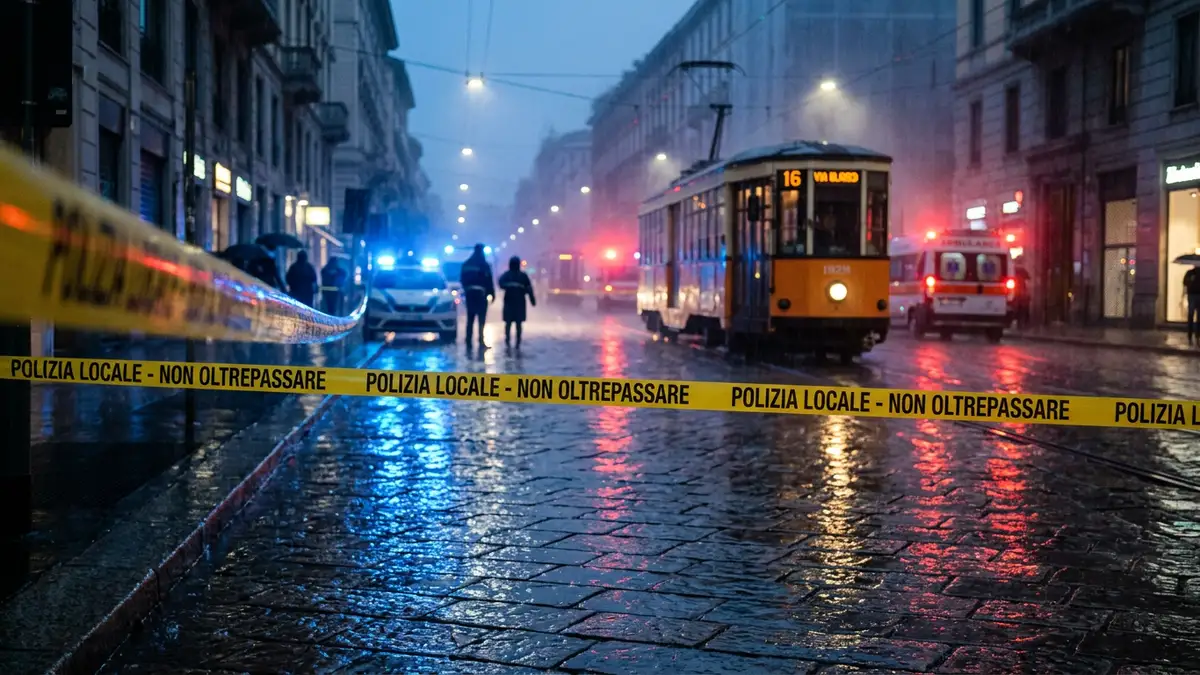
Image: Matt Weston / AI

Sarah Connor
A tram derailed in central Milan on Vittorio Veneto Street, leaving one person dead and at least 20 others injured as emergency crews scrambled to the wreckage.
The vehicle slammed off the rails after entering a sharp corner at high speed, sending the heavy carriage skidding across the pavement. Witnesses at the scene observed individuals trapped on the tracks immediately following the violent impact.
Emergency services and civil protection teams swarmed the site to manage casualties and secure the perimeter. Medical personnel treated 20 injured passengers both at the scene and within local hospitals throughout the afternoon.
Police investigators confirmed the driver slammed the brakes in the moments leading up to the crash. This action served as a desperate attempt to avoid people already situated on the tracks as the vehicle lost its footing.
The driver failed to engage the track switch necessary to maintain a straight path through the junction.
Mayor Giuseppe Sala identified human error as the primary cause of the fatal incident during a press briefing. He stated the driver failed to engage the track switch necessary to maintain a straight path through the junction.
The local transport company, ATM, has not issued a formal statement regarding the technical status of the vehicle. Technicians are currently examining the switch mechanism to determine if mechanical failure played a role in the derailment.
Milan’s relationship with its tram network is foundational, dating back to the system's inception in 1881. This 180-kilometre network serves as a primary artery for 1.3 million residents and thousands of daily commuters.
The fleet operates as a moving museum, featuring iconic 1920s-era 'Ventotto' cars alongside modern Eurotram models. This mix of century-old engineering and contemporary technology presents constant maintenance challenges for the city.
Beyond the historical charm, the municipal government recently allocated over 100 million euros for rail maintenance. These fiscal cycles aimed to modernise the fleet and improve safety across the Lombardy region.
Economic pressure on the city’s transit budget remains high as officials balance heritage preservation with urgent safety upgrades. Public stakeholders and transit unions are now scrutinising safety protocols at every track junction in the city.
The derailment forced ATM to reroute surface traffic throughout the central district to avoid the wreckage. Multiple transit lines remain disrupted as investigators process the scene on Vittorio Veneto Street.
Emergency crews utilised heavy lifting equipment to clear the twisted debris from the roadway. The identity of the deceased individual has not yet been released by city officials pending family notification.
This incident follows a series of infrastructure investments intended to reduce transit accidents across the urban grid. The failure to switch tracks remains the focal point of the ongoing municipal investigation.
The physical layout of the central district, with its tight turns and dense pedestrian traffic, complicates tram navigation daily. Investigators are currently measuring the exact speed of the vehicle at the moment it entered the curve.
Transit unions have previously raised concerns regarding the workload and training of drivers operating on these historic lines. The intersection of human operation and automated switching systems is now under intense review by safety boards.
The Vittorio Veneto Street corridor stands as one of the busiest segments of the urban rail map. Its closure has created a significant bottleneck for the city's morning and evening transit windows.
Beppe Sala reiterated that the investigation will focus on why the track switch was not engaged at the critical moment. The city's transport authority is expected to provide a full technical report once the mechanism is tested.
The investigation will focus on why the track switch was not engaged at the critical moment.
The 100 million euro maintenance fund was specifically designed to prevent mechanical failures at these critical junctions. This derailment tests the efficacy of those recent regional infrastructure investments under real-world pressure.
Local hospitals remain on high alert as they continue to monitor the condition of the 20 injured survivors. Some passengers were pulled from the wreckage by bystanders before first responders arrived on the scene.
Crews hauled the wreckage of the tram car to a secure facility for further forensic analysis this evening. Technicians will look for signs of metal fatigue or electrical faults in the switching array.
Future safety protocols may include automated speed governors at known sharp corners to prevent similar high-speed derailments. For now, the focus remains on the specific failure that occurred at the Vittorio Veneto junction.