Middle East Airspace Closures Force Massive Logistics Reshuffle Ahead of Australian Grand Prix
Aviation hubs face gridlock as Formula One redirects 1,000 personnel and equipment shipments following regional strikes
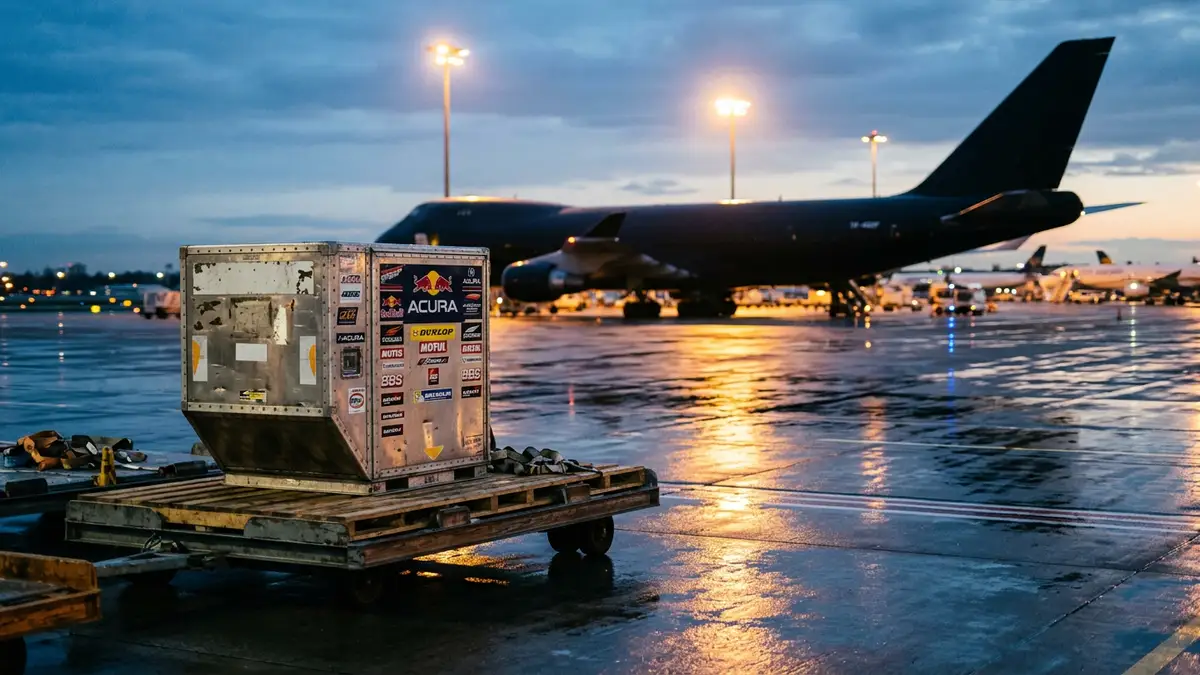
Image: Matt Weston / AI

Carla Rooney
Formula One's Australian Grand Prix will proceed as scheduled despite severe travel disruptions triggered by the escalating Middle East crisis.
Australian Grand Prix Chief Executive Travis Auld confirmed the logistical pivot followed 48 hours of intensive, around-the-clock scheduling. 'The last 48 hours have required some reshuffling of flights,' Auld stated.
Logistics teams successfully shipped cars and equipment from Bahrain before the most widespread aviation disruptions took hold. This early movement prevented primary technical assets from being stranded in the conflict zone.
F1 are experts at moving people around the world and so they've quickly rescheduled flights.
Auld maintained that the operational shifts will remain invisible to the public. He noted that the new arrangements are now finalized to ensure the event remains unaffected by the chaos elsewhere.
'My understanding from talking to them this morning is that's all now been locked in, everyone will be here ready for the race,' Auld said. He insisted that fans in the stands will not notice any difference in the spectacle.
This disruption follows a military escalation that fundamentally altered the regional security landscape. Iran fired at United States assets and allies across the Middle East in a direct response to an attack by the US and Israel.
These kinetic strikes resulted in the death of Iran's supreme leader, Ayatollah Ali Khamenei. The fallout sent shockwaves through international diplomatic and sporting circles.
Donald Trump stated that talks with Iran's political leadership will occur following the US-Israeli strikes. Meanwhile, the United Arab Emirates partially and temporarily closed its airspace during the height of the military activity.
This closure created immediate bottlenecks for international travelers and sporting professionals stationed in the Gulf. A representative for tennis player Daniil Medvedev is currently establishing how the athlete can travel to California.
Medvedev is scheduled to compete in next week's Indian Wells tournament, but his arrival remains contingent on finding a viable path out of the region. The instability has already forced the cancellation of development tests in Bahrain.
Formula 1 scrapped these sessions citing specific security concerns for teams and engineers on the ground. Security fears also impacted the entertainment lineup for the season's start.
DJ Rick Jansen will miss the first three F1 races due to these heightened safety risks. The FIA is currently prioritizing the safety and wellbeing of all personnel for upcoming Middle East events.
The Bahrain Grand Prix and the Saudi Arabian edition remain on the calendar for next month despite the proximity to the conflict. A Formula 1 spokesperson noted the distance between current events and those specific fixtures.
Everyone will be here ready for the race.
'Those races are not for a number of weeks,' the spokesperson said. Broader sporting schedules face similar uncertainty as the conflict persists without a clear resolution.
The 'Finalissima' football match between Spain and Argentina, slated for Doha, is now in doubt. Expectations are mounting that remaining matches in the region will be called off as security protocols tighten.
Organizers continue to monitor the viability of hosting international events in the current climate. Australian Grand Prix organizers expressed confidence that the opening race will remain insulated from further delays.
They cited the sport's internal logistics capabilities as the primary reason for the stable outlook in Melbourne. 'F1 are experts at moving people around the world and so they've quickly rescheduled flights,' Auld said.
He reiterated that the grid will be full by the time the session begins. However, some individuals are still expected to miss the start of the season entirely due to the specific timing of their original travel routes.
These absences are not expected to halt the primary race proceedings or the broadcast schedule. The sport continues to navigate a landscape where geopolitical volatility directly dictates the movement of its global workforce.
For now, the Melbourne circuit remains the immediate focus for the 20 drivers and their support crews. The logistical success in Australia serves as a template for future disruptions in an increasingly volatile global environment.
Related Keywords
Australia