Glasgow Central Station Closed Following Massive Fire at Historic Vape Shop
More than 250 firefighters battle blaze as officials warn of multi-day rail disruptions and structural collapse
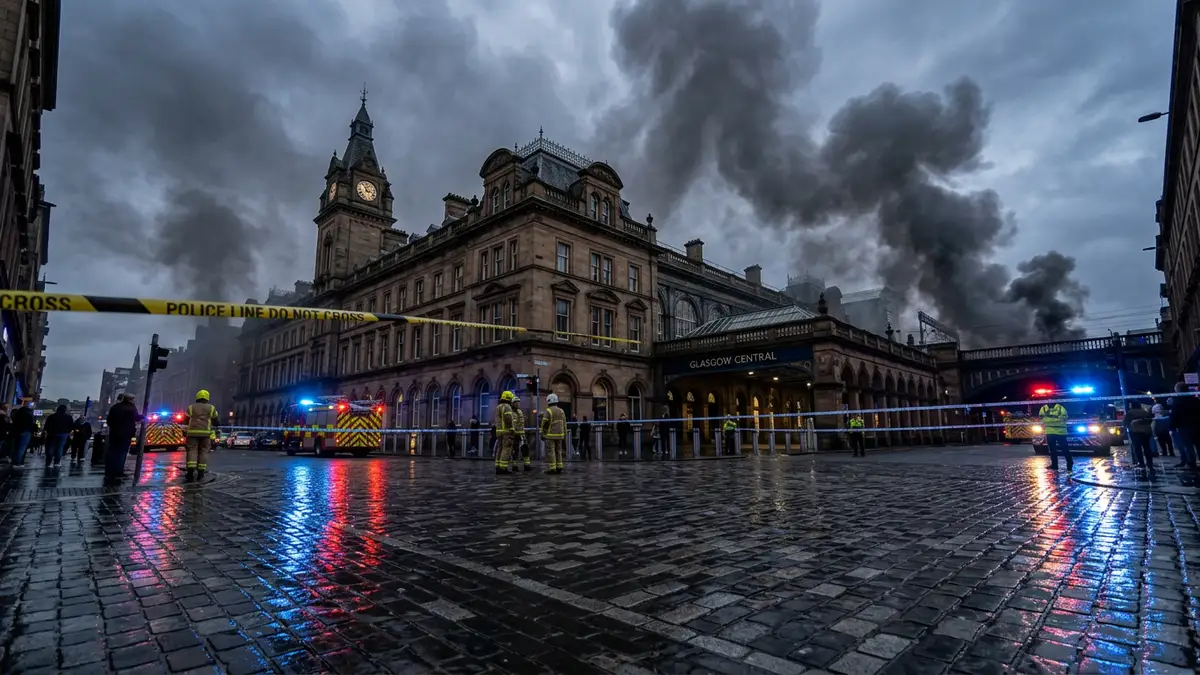
Image: Matt Weston / AI

Sarah Connor
A massive fire at a vape shop near Glasgow Central station has forced the total closure of the transport hub and caused a partial collapse of a historic building.
The Scottish Fire and Rescue Service (SFRS) mobilized more than 250 personnel throughout the night to battle the aggressive flames. This massive emergency response followed reports of a fire that has now triggered widespread rail disruption across the entire region.
The SFRS confirmed that there were no reported casualties from the incident. Despite the lack of injuries, National Rail stated that there is currently no estimate for when the station might safely reopen to the public.
Commuters face a grim start to the week as disruption is expected to continue throughout Monday. ScotRail issued a formal warning that the impact on travel will likely persist for several days as the site remains hazardous.
A Network Rail spokesperson confirmed the station will remain closed today and likely tomorrow. Consequently, all trains scheduled to arrive at or depart from Glasgow Central are being cancelled or revised indefinitely.
The targeted building, which dates back to 1851, suffered catastrophic structural damage during the height of the fire. Labour MSP Paul Sweeney described the structure as a gutted shell, comparing the visual devastation to the aftermath of the Blitz.
A gutted shell, comparing the visual devastation to the aftermath of the Blitz.
Beyond the immediate wreckage, Sweeney reported that the remaining facade onto Gordon Street is now likely to be demolished. Building control officers indicated they have little hope that the historic structure can be salvaged at all.
Witnesses at the scene reported hearing distinct explosions echoing from inside the building during the early stages of the fire. These blasts are believed to have been caused by lithium batteries used in vape devices stored on the premises.
Local witness Lamin Kongira claimed the fire originated from a bank of chargers located directly under a shop counter. Callum Robertson also suggested the cause was electrical in nature, pointing to the density of hardware in the unit.
Assistant Chief Officer David Farries stated that it is not yet known how the fire started or exactly what was inside the building. He confirmed a full investigation with multi-agency partners is required to understand why the fire spread with such lethal velocity.
It is not yet known how the fire started or exactly what was inside the building. A full investigation with multi-agency partners is required to understand why the fire spread with such lethal velocity.
First Minister John Swinney was briefed that the fire originated in the vape shop located within the block. Swinney stated the Scottish Government is willing to assist the city council with the significant financial consequences of the disaster.
The SFRS confirmed a preliminary investigation is underway but noted they cannot speculate on the cause at this early stage. Meanwhile, TSSA General Secretary Maryam Eslamdoust demanded a thorough investigation to prevent future occurrences of this scale.
Reform UK councillor Thomas Kerr called for the temporary removal of all vapes from shelves while the full investigation is carried out. Arslan Ali described the once-grand Victorian block as nothing but a pile of rubble following the incident.
Business owners in the immediate vicinity reported total losses as the fire consumed their livelihoods. Sam Hendry stated that everything has been wiped out, while Carolyn Bowie called the event a massive blow for the city of Glasgow.
Despite the ruin, the owners of Sexy Coffee announced their intention to rebuild and revamp their shop as soon as possible. Network Rail confirmed that reopening timescales will only be set once they can safely access the site for structural checks.
The closure of Glasgow Central remains the primary driver of travel chaos across the Scottish rail network. Commuters are advised to check for revisions as the structural integrity of the surrounding buildings is assessed by engineers.
This Victorian architecture of the 1851 block represents a significant loss to the city's architectural heritage. Its potential demolition marks the end of a century-and-a-half of Glasgow's commercial and social history.
Economic pressure mounts as local businesses face the reality of total inventory loss and zero footfall. The Scottish Government's offer of financial assistance highlights the scale of the economic impact on the city centre.
The incident raises urgent questions regarding the storage and charging of lithium-ion batteries in high-density urban areas. Regulatory shifts may follow as officials investigate the mechanics behind the rapid spread of the flames.
Emergency crews remain on-site to monitor hotspots and prevent further collapse of the weakened masonry. The perimeter around Gordon Street remains cordoned off to all pedestrian and vehicular traffic for the foreseeable future.
Final assessments of the station's safety depend entirely on the stability of the adjacent gutted shell. Until building control officers clear the site, the rail network across Scotland faces a sustained period of paralysis.