Roman Villa Complex Unearthed in South Wales
Discovery challenges historical perceptions of the region.

Callum Smith
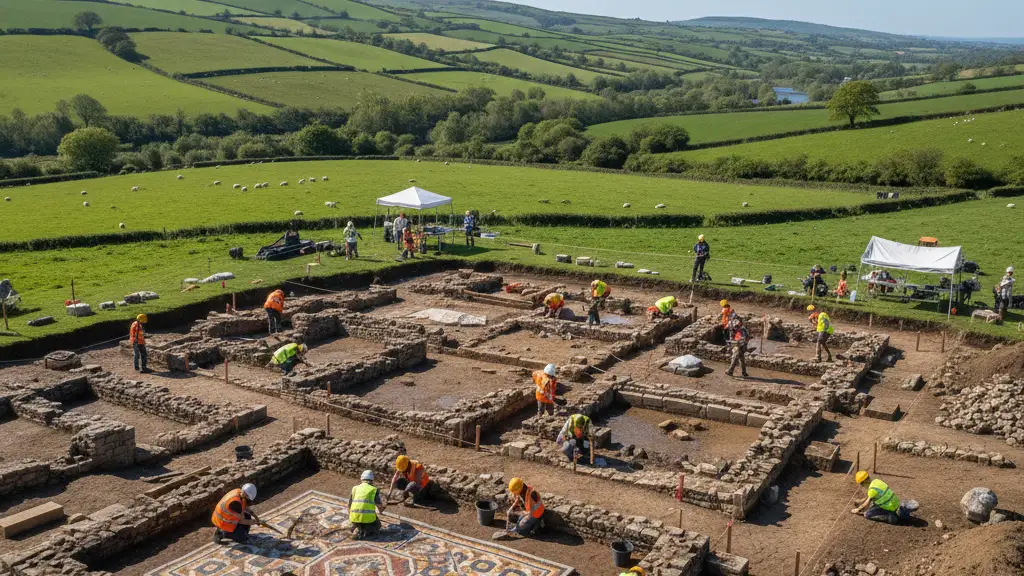
A vast Roman villa complex has been discovered in South Wales.
The site's extraordinary preservation stems from centuries of minimal agricultural disturbance, leading experts to describe it as potentially 'Port Talbot's Pompeii.'
Geophysical surveys by Swansea University's Centre for Heritage Research and Training (CHART) revealed the unexpectedly large complex.
The discovery challenges long-held assumptions about south Wales' significance during the Roman period.
Alex Langlands, an associate professor of heritage and history at Swansea University, stated the area was not on the fringes of the Roman empire but an integral part of it.
The villa likely dates to the 4th century and may rival the grand stately villas found elsewhere in Britain.
Surveys also identified a substantial aisled building, believed to have served as a barn or communal hall for a wider agricultural estate.
Archaeologists expect to uncover significant features including mosaics, paved floors, painted wall plasters, and underfloor heating systems.
High-status sculptures may also be found, given the villa's potential grandeur.
The discovery is part of a collaborative project designed to foster local interest in the region's historical assets.
The initiative aims to engage communities and highlight heritage as a valuable resource for Neath Port Talbot.
The find is expected to drive interest in the park and bring broader benefits to Neath Port Talbot and Wales.
Related Keywords
Wales