Jodrell Bank's Lovell Telescope Faces Funding Cut, Sparking Public Outcry
UKRI withdraws support for historic observatory amid broader science budget pressures, jeopardising 28 jobs and critical research.

Callum Smith
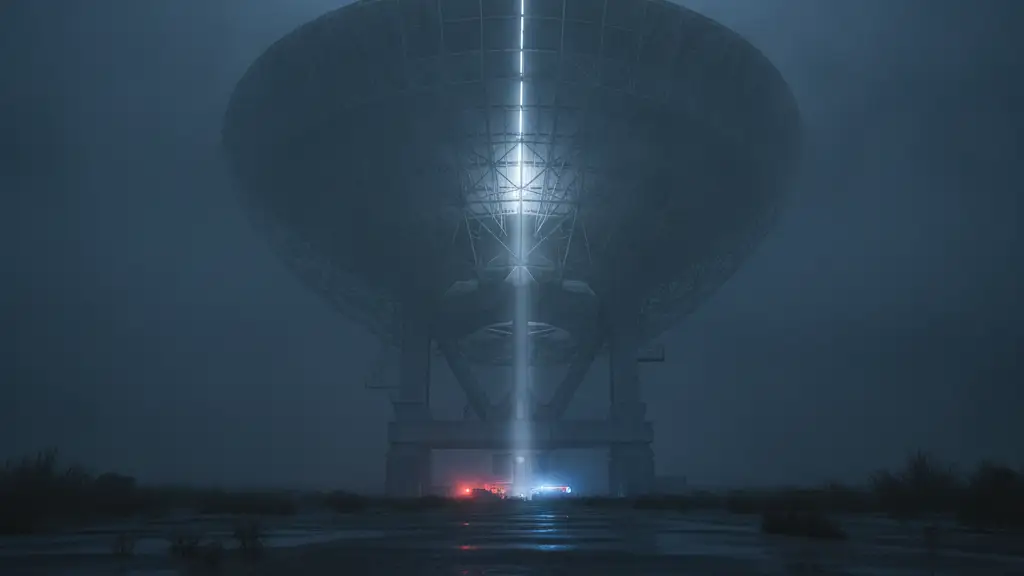
Hundreds of individuals have signed a Manchester Evening News petition, demanding the preservation of the iconic Lovell Telescope at Jodrell Bank Observatory following a decision by UK Research and Innovation (UKRI) to withdraw its funding.
During the Cold War, Jodrell Bank assumed a covert, vital role, providing a four-minute warning of impending nuclear attack.
The telescope further cemented its legacy in 1966, intercepting and printing the first-ever pictures from the Moon's surface. Its contributions earned Jodrell Bank Unesco World Heritage status in 2019.
The Science and Technology Facilities Council (STFC), an industry body within the Department of Science, Innovation and Technology, now grapples with substantial financial pressures. The STFC must achieve £162 million in savings by 2030, facing a forecast cost overrun of £684 million for the latest spending review period.
UK Research and Innovation (UKRI) announced its decision to withdraw funding from Jodrell Bank Observatory. This annual grant to the facility totals approximately £2.8 million.
The University of Manchester has warned that this funding withdrawal would bring an end to the space telescope as an "active scientific instrument for radio astronomy." This decision places 28 jobs at risk, specifically those funded through the e-MERLIN grant, and could affect around 3,000 scientists.
Jodrell Bank has pioneered radio astronomy research since the 1940s. Its work has contributed significantly to the study of black holes, quasars, pulsars, and gravitational lenses.
Jodrell Bank has to be saved.
Petition signatories claim the decision to withdraw funding is 'short-sighted' and a 'false economy.' Graham Stringer stated, "Jodrell Bank has to be saved."
Stringer added, "It has to be saveable if No 10 in the North and rebalancing the country - Andy Burnham's projects - are to survive." He concluded, "It's the first test of his promise - it's absolutely critical for his future and the north of England that he changes this."
Prime Minister Andy Burnham faces growing calls to intervene and reverse these cuts. The broader landscape of UK science facilities also experiences budget pressures, with other sites like the Diamond synchrotron, Isis muon and neutron source, Clara facility, and Boulby mine facing cuts or mothballing.
A significant risk also looms over the LHCb experiment on the Large Hadron Collider, which could terminate early due to lack of funding. This premature termination potentially leaves 80% of data uncollected.
Meanwhile, construction of the Square Kilometre Array (SKA) in South Africa and Australia progresses. Data gathering for this ambitious project is set to commence in five years.
Beyond its scientific endeavors, Jodrell Bank has also served as a vibrant venue for music festivals and artist performances. The Bluedot Festival has hosted appearances by Björk, Sigur Ros, New Order, and Johnny Marr.
The Space Invader pub in Goostrey, Cheshire, has even unveiled a large mural of the Jodrell Bank telescope. This artistic tribute highlights its deep cultural resonance within the community.
The Jodrell Bank Centre for Engagement operates as a separate entity. It remains unaffected by these current funding changes.