Prince Harry and Meghan Markle Review Gaza Aid Logistics at World Central Kitchen Hub
The Duke and Duchess of Sussex joined World Health Organization officials in Jordan to examine food security and addiction rehabilitation frameworks.
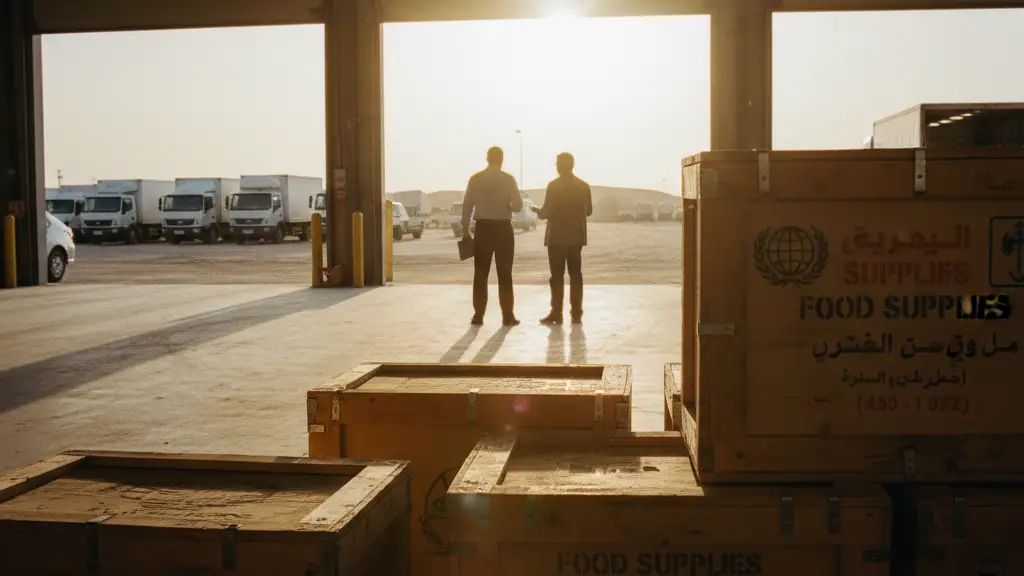
Image: Matt Weston / AI

Callum Smith
Prince Harry and Meghan Markle arrived at the World Central Kitchen regional headquarters in Jordan to inspect the logistics of a massive food distribution network currently deploying one million hot meals daily into Gaza.
Hubaishi confirmed that the current volume of incoming trucks stagnates below the demand. This logistical shortfall hits the World Central Kitchen harder than any other humanitarian actor currently operating in the region.
The 20-truck daily requirement serves as a non-negotiable target for maintaining the current level of aid. Every missed shipment erodes the caloric reserves of the one million meals intended for the civilian population.
The 20-truck daily requirement is a non-negotiable target for maintaining the current level of aid.
Beyond the immediate logistics, the visit establishes Jordan as the critical neutral ground for international aid organizations. Since the establishment of the World Central Kitchen regional presence, the kingdom has functioned as a stable anchor for Middle Eastern relief efforts.
Economic and political pressures on the aid corridor remain high as logistics teams navigate the Rafah border crossing. Each delay at these entry points disrupts the flow of essential supplies across the desert transit routes.
Following the logistics briefing, the Duke and Duchess of Sussex joined a World Health Organization (WHO) delegation for a scheduled visit to the national centre for rehabilitation of addicts. This transition shifted the focus from immediate food security to the long-term clinical frameworks of the Jordanian healthcare system.
The WHO maintains a permanent delegation in Jordan to oversee regional health security and emergency response protocols. During the tour, officials provided technical briefings on the integration of mental health services within the national rehabilitation framework.
This engagement follows a history of royal involvement in global health initiatives and humanitarian logistics. The Sussexes examined how the WHO addresses substance abuse through structured medical and social interventions.
During the tour, the couple moved through the facility without the rigid protocols typically associated with formal state visits. They walked through the clinical wards, engaging directly with the medical staff and observing the facility's daily operations.
The couple's presence in Jordan coincides with a broader shift in how private humanitarian organizations interface with high-profile global figures. These interactions increasingly bypass traditional diplomatic channels in favor of direct operational engagement.
The World Central Kitchen continues to scale its kitchen network to address the escalating food security crisis. The organization’s ability to maintain its output depends entirely on the stability of the supply chain through Egypt and Jordan.
Historically, Jordan has provided the infrastructure necessary for such large-scale international responses. The current crisis has tested this infrastructure, requiring constant coordination between the WHO, private NGOs, and local authorities.
The WHO delegation emphasized that substance abuse treatment is a vital component of regional health security. Their briefings to the Duke and Duchess focused on the sustainability of these clinical programs amidst regional instability.
Substance abuse treatment is a vital component of regional health security.
The logistics of the World Central Kitchen operation involve complex coordination between multiple international stakeholders. Hubaishi reiterated that the 20-truck daily requirement is a non-negotiable target for maintaining the current level of aid.
The visit marks a continued focus on the practical execution of international relief efforts in the Middle East. By reviewing both food distribution and healthcare frameworks, the Sussexes observed the dual tracks of immediate crisis response and long-term social rehabilitation.
The World Central Kitchen remains the primary driver of hot meal distribution in the sector. Its reliance on the Jordanian hub underscores the strategic importance of the region's logistics network.
The WHO continues to monitor the integration of mental health services as a priority for the Jordanian healthcare system. This visit provided a platform for these technical protocols to be reviewed by international observers.
As the food security crisis affects hundreds of thousands, the mechanics of the Rafah crossing remain a central concern for aid directors. The current operation stands as one of the most ambitious private humanitarian efforts in recent history.
The Jordanian government continues to facilitate the movement of these goods despite the mounting pressure on its domestic infrastructure. The coordination between the WHO and the royal house signals a long-term commitment to the region's medical stability.
The technical briefings concluded with a review of the national rehabilitation center's capacity to handle an influx of patients. This data-driven approach highlights the intersection of immediate humanitarian aid and the maintenance of public health systems.
The 20-truck minimum remains the primary metric of success for the World Central Kitchen's mission. Without this consistent flow, the entire humanitarian architecture in the region faces an immediate and catastrophic failure.
Related Keywords
Celebrity